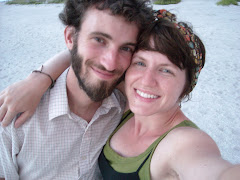
I feel like I should update just to let you know what's happening with us here in Port-au-Prince. We've been busy working in the office, which is something new for us in Haiti. City life is nice (odd to say as the city has been so severely damaged): there are people around, electricity to be had, and an abundance of food items that we don't have in Desarmes. The weather is cooler and the distance between our temporary home at the Depps' and the office is more than a five minute walk (this may sound odd, but when your entire week is composed of walking across the street from your home to the office and the odd 10-minute walk to the center of town, a little distance can be nice).
How is the city? Some days I forget that an earthquake happened because stores have opened again, banks are open, and street vendors are crowding the streets as usual. Of course I didn't lose my home, no one in my family died, nor friends, nor co-workers. Every once in a while a bad smell hits you in the face and you remember what has happened, or you drive down a road and look across the valley and an entire neighborhood is rubble.
It's strange to be in a position of judging the level of need that people have and deciding whether or not they merit help. Most of Haiti would not turn down free food aid, tents, tarps, water, or shoes a few months ago, and now everyone is saying they need help. What do you say to a family who hasn't lost their home? What do you say to someone who is still employed and earning a salary? Sometimes the people that have the means and know how to ask are the ones that find aid before those that have more need but don't know how to ask for help.
The other difficult part about watching "aid" pour into the country is that a lot of the aid is going to Americans or Canadians or other international staff members. They are being paid with donation dollars and living and eating within the walls of the UN compound and all sorts of new vehicles and motorcycles are flooding the roads. I can judge other international workers just as much as I can be judged, I guess, but it's just the idea that millions of aid dollars are coming to...pay the salaries of non-Haitians, buy imported foods, etc.
Trying to finish this post... a few days later. Yesterday we dropped Ben and Alexis off at the airport and then we went over to the UN logistics base to try yet again to get IDs for easier access into the logistics base to coordinate with other NGOs or simply get more information about what is really happening here. I left there frustrated, and the drive to the office only heightened my frustration with everything, the international aid response, the traffic, work, etc. The prospect of going to the office just overwhelmed me and as I dropped off Sharon I hopped on a motorcycle to go "home." I got back, showered and sat with my book until I finished it and hung out in utter bliss in my 100% complete privacy (well, except for the cat).
All this to say, it's a bit surreal at times being in the position I'm in and the gravity of the new reality that is here in Haiti. Everything feels somewhat different now, and the country I've come to know over the past 1.5 years is a new place and the job I've come to know over the past 1.5 years is a different job.
Showing posts with label work life. Show all posts
Showing posts with label work life. Show all posts
Monday, February 8, 2010

Sunday, November 29, 2009
worms
One of the things we brought back with us from our trip to MPP the week before last was about a pound of red worms. I've been thinking about vermicomposting for quite a while now, but the thought of buying worms on the internet and having them shipped in the mail just seemed too excessive. So when presented with an organization that has an abundance of them and will give you a bucketful of worms for about $15 we figured...why not? We split the cost with the Depps, so half went off to Port to be city worms and the other half are here with us in Dezam.

MPP fed their worms a steady diet of horse droppings and then used the worms to feed their chickens. I've heard a lot about how worms can eat a lot of kitchen waste. We cook with vegetables almost every day and produce a fair amount of organic waste. Despite our best efforts, our other methods of composting haven't been able to keep up with the amount we produce. So I put the worms into a smallish Tupperware container (hopefully temporary, as I have read they like lots of room to roam around - they like to be able to escape hot spots or excess water or dry spots or whatever they don't like at the moment). After a week of feeding them cabbage, beets, bananas, and tomatoes they still prefer horse droppings (which I have been, um, gathering from the road).
I'm not sure if I should try to wean them from their addiction or just let them indulge in their sweet tooth as there is plenty of horse poo around for them to chow down on. The only problem is that our compost predicament gets no help, but now we can have a bunch of nutrient-rich fertilizer for our garden.
Well, next time you need a laugh you can imagine me walking the streets of Dezam with a bucket and little shovel looking for horse droppings - when people ask me what I'm doing I tell them I'm looking for food for my worms.
Another funny/sad thing: I was just informed that Haitians generally hate worms and will kill them when they see them in the garden because they look similar to snakes. Really? Isn't that a bit excessive? I heard this a few days after I heard that farmers in the area are killing honey bees because they don't like them. I asked them why and explained that without pollinators every garden in the area would be in a lot of trouble. Response: smiles and nods. A little piece of my hope for environmental recovery was lost.
Anyway, here's to living bees, thriving worms, and a Haiti developing into the lush tropical wonderland it could be.

Monday, November 23, 2009
A Tale of Two Papayas
Last Thursday, the environmental education team trekked to the Central Plateau to visit Mouvman Peyizan Papay, a 36-year-old peasants' movements in the town of Papaye. We are planning to bring all the teachers in our program here in December, so we came to check out MPP's work and make arrangements for our excursion with their staff.
We started with a tour of their experimental gardens, learning about their soil mixture, irrigation systems, and permaculture strategies:

Their small-animal husbandry addresses the problem of elvaj lib (in which goats and other animals roam freely and eat what they like from various gardens). These goats are fed from the farm - the woody stems they don't eat are later used to build erosion barricades on sloped land.

Tire gardens protect plans from ranging chickens and provide a more controlled environment for managing the soil:

The mandala garden was bursting with garlic chives, cabbage, chard, peppers, and spinach:

This horse was not technically part of our tour, but isn't this one of the greatest saddles you've ever seen?
 I think our teachers are going to have a terrific time.
The second papaya is a little closer to home. Our neighbor/landlord let us know that she disapproves of our rooftop garden:
"Why are you growing those papayas? You know they won't do anything."
"Yes, but it's more for fun [and shade] than anything..."
Pilgrim's Progress-fashion, we've nicknamed her Madam Pa Renmen (Mrs. Doesn't-like) because of her many complaints. If she can see us do it, she doesn't like it. It's hard to take her seriously after a while. This is a situation we're trying to improve with a spirit of humility and cooperativeness, but in the meantime I've realized that "love your enemies" and "love your neighbors" are basically the same commandment.
We started with a tour of their experimental gardens, learning about their soil mixture, irrigation systems, and permaculture strategies:

Their small-animal husbandry addresses the problem of elvaj lib (in which goats and other animals roam freely and eat what they like from various gardens). These goats are fed from the farm - the woody stems they don't eat are later used to build erosion barricades on sloped land.

Tire gardens protect plans from ranging chickens and provide a more controlled environment for managing the soil:

The mandala garden was bursting with garlic chives, cabbage, chard, peppers, and spinach:
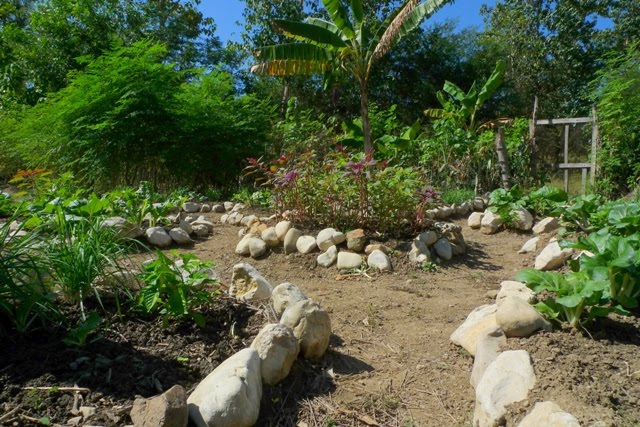
This horse was not technically part of our tour, but isn't this one of the greatest saddles you've ever seen?
 I think our teachers are going to have a terrific time.
The second papaya is a little closer to home. Our neighbor/landlord let us know that she disapproves of our rooftop garden:
"Why are you growing those papayas? You know they won't do anything."
"Yes, but it's more for fun [and shade] than anything..."
Pilgrim's Progress-fashion, we've nicknamed her Madam Pa Renmen (Mrs. Doesn't-like) because of her many complaints. If she can see us do it, she doesn't like it. It's hard to take her seriously after a while. This is a situation we're trying to improve with a spirit of humility and cooperativeness, but in the meantime I've realized that "love your enemies" and "love your neighbors" are basically the same commandment.
Thursday, November 12, 2009
Too many motorcycles? Or, in search of a silver bullet.
Each week during our team meeting, we each have the chance to share news: local, national, and international. As TV is almost nonexistent and the internet is available only to some, the local radio is Haiti's #1 news source. Yesterday we talked about the new prime minister, the local soccer team, and then one story topped them all. Frantzo told us about a recent study that has at last figured out what Haiti's development problems are: motorcycles.
According to this study, there are 4 million made-in-China motorcycles in Haiti, and the purchase of one of these apparently causes the new owner to drop out of school and stop doing anything that contributes to sustainable development. So if all we have to do to "save Haiti" is get rid of all these motorcycles, what are we waiting for?
"Really, Frantzo? You have a motorcycle and you do development work."
"Well, it's not people that work for an organization, but private people."
Our team finally concluded:
- 4 million motorcycles would mean every other Haitian owns one. In Michelet's hometown of Valere, to take one example, he estimates there are 5 motorcycles and approximately 30,000 people. Looks like Valere is short by 14,955 motorcycles.
- Most motorcycles are not private vehicles but are small businesses - the owners "make traffic" (it's so great that that's the verb) by operating their bikes as moto-taxis. So if there are no moto-taxis that would mean even fewer jobs, right? They are indeed dangerous, but there are already a lot of young men hanging out with nothing to do, and taking away all the motos in Dezam would create another sort of crisis. I'm all for advocating bicycles over motos but putting blame on motos as a stumbling block to development seems like a unliklely culprit.
- Moto-taxis make it much easier to take goods to market. With a motorcycle you can carry drums of oil, sacks of produce, 4 or 5 people, and we once saw someone carrying another motorcycle.
- Yes, it is bad that so much Haitian money ends up in the hands of Chinese manufacturers, but that's a problem faced by more countries than this one. Hey, maybe the solution is to start a business manufacturing Haitian motorcycles! Anybody up for a new development project?
As a final note, as I was searching for verification of this story I came across a new website: www.wehaitians.com, which seems to be a news source for Haitian diaspora. Here I learned President Preval is again a married man. Congrats.
Tuesday, November 10, 2009
It's that season again...
...for Vodou, that is. In the Artibonite Valley we hear the night-drums and see the assorted odd bits of Vodouiana from about Halloween to Easter. Last year we nearly stumbled into a torchlit cow-sacrifice processional as we locked up the office gate one night, and I'm hoping to avoid that experience this year.
Not only has the subject of Vodou recently appeared here and here, it came up in conversation yesterday with our teammates Frantzo and Fritzner. As we returned from a meeting with a group in the next town over, Bryan accidentally ran over something we've come to recognize as clearly Vodou: a calabash bowl with a candle in it sitting in an intersection. Everyone hastily reassured Bryan that because it was the truck that broke the bowl, and the truck is not alive, it would be fine because magic can't affect machines.
Well!
me: So if trucks represent technology, can we say that technology is more powerful than Vodou magic?
Frantzo: Yes! If everyone had technology, Vodou would be finished. The more technologically-advanced people become, the less they rely on Vodou.
Fritzner: Yes, Vodou definitely gets in the way of development. If it helped, then Haiti and Africa would be the most developed nations on earth.
(So - can we think of technological development as a form of evangelism?)
It's really interesting to me to think of the role that people expect religion to play in their lives - F & F seem to think that Vodou fulfills some need that is more apparent when physical needs are not being met, but once a person is able to meet basic needs the role of Vodou in the life of that person drastically shrinks.
The Artibonite Valley is known as the Scary Center of Vodou by people in other parts of Haiti, but it seems to me that what F & F point out is true. People turn to Vodou when there's an illness the local hospital can't address. They turn to Vodou when they feel like someone is taking unfair advantage of a situation. They use Vodou to access power that feels otherwise remote.
Is this an indictment of the Christian church? Of the Haitian government?
Dismissing Vodou as a religion of the peasants is sort of akin to throwing out the cultural baby with the ceremonial bathwater, since Vodou has long been the primary way that Haitians have addressed questions of spirituality. I think it's important to take that means of expression seriously and pay attention to what it can tell us about a perception of God that is unique to this culture.
I know a lot of evangelical Americans in particular think that Haiti is the way it is because of the practice of Vodou, but it might turn out to be just the opposite.
(By the way, be sure to check out the American Museum of Natural History's archived exhibition, The Sacred Arts of Haitian Vodou. It provides a nice overview that covers many aspects of the religion.)
Monday, November 9, 2009


Wednesday, October 14, 2009
Nothing to see here.
Last week was jam-crammed with introducing new MCCers to Dezam, our quarterly MCC Haiti meeting, and a trip to Port to help friends move and meet a brand-new baby. But despite my nicely filled-in calendar for this week, I've had one cancellation after another:
- The teacher whose class I went to visit Monday morning was sick and the substitute was covering two classrooms and couldn't teach the environmental lesson.
- Our regular education-team meeting was canceled yesterday because we needed to go to St. Mark to renew the insurance for MCC motorcycles.
- My English student didn't show up for his lesson.
- Our weekly team meeting was canceled because the reforestation team is distributing money to the nursery committees at the bank.
- Our second attempt at an education-team meeting today was canceled because...well, I'm not sure why.
So if anyone can pass along suggestions for a super time-consuming project, I'm all ears.
Friday, July 17, 2009
Making treasures
This week the environmental education team hosted a program in "trash formation" with a group called the Asosyasyon pou Konbat Fatra Plastik (the Association Against Plastic Trash, or the AKFP). We invited nine extra-interested kids from our Environmental Agents program to participate in the 5-day training.
The goal was to learn how to make these:
 - which are fashioned from snack wrappers and strips of cardboard (cut from USAID vegetable oil shipping boxes, naturally). Not only is this a creative way to transform unsightly used packaging into something useful and pleasing, it gives these kids the tools to start a small business if they choose.
They divided into teams, each person cutting, folding, and stitching together the long strips.
 After a day or so, they warmed up to each other and passed the time having fun hanging out.
 See? It's not a sweatshop!
 (Remember the Agent on the far right? That's Silmique, who rocked the mountaintop tree planting day a few weeks ago. He confirmed overachieverness today when he mentioned that he's already started making these bags at home in the evenings. No, he says, his hands aren't sore from all this detailed finger-work.)
A few of the finished products:

So this is a dream development project, right? It offers a creative solution to Haiti's ubiquitous trash problem and provides a way for kids to make money and protect the environment.
Win-win...almost. I do think it's a great project, given a few caveats:
1. "All Haitians have is trash, and they make such great things with it!" True, there is a lot of trash here, but there is a danger in thinking that empty plastic wrappers are the only resource this country has. Making these items can be seen as a true act of creativity, since Haitians aren't obligated to work with these materials any more than Americans are.
2. Finding plastic trash is easy, but finding carboard is surprisingly difficult. It can be had, but having it might present too much of a challenge to starting a business.
3. Where is the market for these bags? At $15-20 US each, they're out of the price range of the average Dezam area resident - and as Frantzo pointed out, you can buy a goat for that kind of money, which will reproduce and create a return on your investment.
(If I could step on a tiny soapbox for a minute: price is actually a really interesting question. $20 is next to nothing for a week's worth of work, but all too often tourists and travelers are on the hunt for bargain-basement souvenirs and treasures: "I got this great handmade X for $2!" We in the developed world need to change the way we financially value the labor of others, regardless of where they live.)
4. Reusing does nothing to reduce consumption, of course still the primary way to reduce trash production.
I am encouraged by the fact that these issues are being addressed by AKFP and my Haitian coworkers. This morning they discussed the idea of having multiple price points to allow more working- and middle-class Haitians to afford the bags. They discussed the value in using these bags with pride, showcasing local handiwork. They recognized that this is a stopgap measure while we all work on reducing consumption.
And that discussion, my friends, is something of a development dream come true.
Wednesday, June 24, 2009
There I'm happy, I'm planting trees -
Oh hallelujah, nature is more beautiful!
- so goes the song.
Today we hosted a konbit, or work day, to plant trees on a nearby mountaintop called Three Ravines. Mountaintop-planting is one of MCC Dezam's priorities for the year, and this konbit also gave our 4th- and 5th-grade "Environmental Agents" the chance to participate.
The kids marched through the center of Dezam carrying trees and singing before we hopped in big trucks and headed up the mountain:
 I also think this kid in his sneakers is
adorable. He totally deserves to be line leader.
 Most cases hold 96 trees, and we carried up about 65 of them.
 He lives near where we parked the trucks, tagged along, and
was a tree-mendous help. (Ah, the pun was just too easy!)
A truly amazing Agent, Silmique can heft the heaviest loads without complaint:
 This was him taking a break.
 These folks worked so quickly we could hardly get trees
in the newly-dug holes fast enough.
 In many community konbits, people work in exchange for a meal (the same way that North Americans are obligated to buy pizza for friends who help them move). What a beautiful valley it is, and how tree-filled it will one day be.
- so goes the song.
Today we hosted a konbit, or work day, to plant trees on a nearby mountaintop called Three Ravines. Mountaintop-planting is one of MCC Dezam's priorities for the year, and this konbit also gave our 4th- and 5th-grade "Environmental Agents" the chance to participate.
The kids marched through the center of Dezam carrying trees and singing before we hopped in big trucks and headed up the mountain:
 I also think this kid in his sneakers is
adorable. He totally deserves to be line leader.
We parked the trucks and loaded up with cases of seedlings to continue upward on foot. There's no photographic documentation, but both Bryan and I carried cases Haitian-style. It's both easier and more tiring than it looks:
 Most cases hold 96 trees, and we carried up about 65 of them.
Not even an official Agent, this kid was amazing:
 He lives near where we parked the trucks, tagged along, and
was a tree-mendous help. (Ah, the pun was just too easy!)
A truly amazing Agent, Silmique can heft the heaviest loads without complaint:
 This was him taking a break.
Several local officials and two community nursery committees helped organize the konbit:
 These folks worked so quickly we could hardly get trees
in the newly-dug holes fast enough.
We headed back down the mountain for lunch:
 In many community konbits, people work in exchange for a meal (the same way that North Americans are obligated to buy pizza for friends who help them move). What a beautiful valley it is, and how tree-filled it will one day be.
Sunday, June 14, 2009
Mixed reviews.
Livrezon is finished! We distributed thousands of trees from 22 community nurseries in 7 work days. Phew. This morning I relaxed and slept in until 6:30am.
It was pretty interesting, actually, to have the chance to go on a condensed "tour" of the nurseries and see the committees (and communities) in action. Some committees ran the distribution like old pros, asking people to line up and calmly wait for each kind of tree. In other communities the receivers were less gracious, pressing impatiently against one another as they waited their turns - and even turning up their noses at certain species.
While on the one hand watching seedlings go out into the big wide world in the hands of people who will care for them is heartwarming, and makes the last year's work all seem worth it, there is something about the tree distributions that made both Bryan and me uncomfortable. We knew that some trees were sold and some were given away - but for some reason we thought that most of the trees were sold; in reality, the nurseries give away 90% of the trees and reserve only a few to sell. We thought that if someone pays for something, even just a nominal fee, that person is more likely to value and care for that thing, right?
As usual in Haiti, it's complicated. Since MCC has been giving away trees for most of its 25-year history, it's hard to change this strategy quickly (a former MCCer in Dezam pointed out that MCC nurseries only started selling trees within the last 5 years). The community members expect a certain number of trees, and in a way, not giving them trees is a vote of unconfidence, a gesture that would be perceived as a lack of faith in their ability to plant and care for trees. Also, if our primary goal is reforestation and not community development, it makes sense to take advantage of the thousands of volunteers willing to plant and care for trees on their own land.
Community development, however, is an overarching goal of the program. Even in the short time we've been here, I've noticed how people take pride in their work with MCC. Our teachers and nursery committee members are learning about community organizing, running small businesses, and getting students involved. As foreigners in Haiti, a country where many people have developed a mentality of dependency on foreign aid (with the accompanying expectations and attitudes of entitlement), MCC's emphasis on empowering Haitians to run this program has been its most heartening aspect. From this perspective, grand-scale distributions make us feel like just another couple of white people here to hand something out.
Last week, a few people frustrated with the number of trees they were getting (only about 25 each) told Bryan, "If MCC won't give us trees, we'll just grow our own!"
So, um. Wouldn't this be the best possible outcome, that the people living in these communities would start to improve the land on their own?
Maybe we should start to rethink the way MCC's program approaches the issue of deforestation, encouraging communities to think of our nurseries as a resource for their own endeavors.
-posted by Sharon, from Bryan's account
Friday, May 29, 2009
May Retrospective
Wow, how the weeks fly by! Here's a little of how we've been filling our time this month:
The Great Cherry Meltdown.
Our resources in Dezam are limited even compared to those of our coworkers inPort-au-Prince 
The Great Cherry Meltdown.
Our resources in Dezam are limited even compared to those of our coworkers in

And this behind our house:
 And this at the MCC office:
 The lesson, it turns out, is to keep my eyes open to what's happening all around me. It might just be the thing I think I'm missing.
Visitors from the North.
Hooray for: Beth & Jason! We had a fantastic time showing them our favorite haunts, checking out the local arts scene, and cooking up a tasty cherry crumble. After receiving B&J and Bryan's parents, and hanging out in Dezam with the Steckleys last week, we can say again that we LOVE having visitors (hint hint, for those of you weighing the pros and cons of trekking to the
Taking to the seas.
Last Sunday a group of MCCers, visitors, and friends headed to a small island off the coast of our small island home for a day of snorkeling and splashing in the waves.
For photos and details, click through to Rebekah H.’s blog.
Induction into MCC's Ajan Anviwonman Program.
Well, we didn't actually become Agents, but the Environmental Education Program welcomed 30 new students (2 from each partner school) as AAs. These kids were selected by their teachers based on their enthusiasm for protecting the environment, and MCC's program plans special activities throughout the year to encourage them to pick up trash (or reduce their trash creation in general), plant trees, and spread the green word to other kids.
Changing of the Season.
Goodbye dust, hello mud: After months of hauling water from the river for our garden, the rains have come and brought everything back to life!
 We hadn't realized how much we missed the sound of rain until we started hearing it again. This means that our water worries are over (no more driving to the river to find water for our garden) but our electricity worries have begun (less sunshine means less time for our solar panel to convert rays into power).
The arrival of

I’ve become a bike widow again, but I don’t resent for a minute the pleasure he gets from tooling around on two wheels. We cannot thank the many hands that made its arrival possible. Danny and Courtney pulled it out of their basement and got it boxed up, Beth and Jason lugged the thing around a few airports and Frazer Mennonite paid the oversize luggage fee. We can't thank you all enough for making this happy reunion possible – THANK YOU!
Monday, April 20, 2009
So what's your question?
That is what I asked a nursery worker about 5 times this morning.
I went to do a regular nursery visit, which was only my second without another member of the MCC team with me (despite the past 7 months, I'm still new to this). It started off pretty well: we filled plastic planting bags with soil, planted seeds, situated them, and counted all the trees to keep up to date with the number they have in the nursery. As we're wrapping up, we move on to a few points of discussion.
O
ne of the nursery guys says he has a question. Okay. He says, "I think it's a good idea for everyone to show up for work days."
Okay, what's your question?
He says, "Maybe you don't understand Creole too well."
Okay. What's your question?
Another person says, "If we have a work day, it's much better when we're all here."
Yes, I agree. Still: question?
They start getting angry and frustrated that I'm not understanding. Finally I realize they're having a problem with everyone showing up, and want someone else (i.e., me) to reinforce the rule that everyone should participate in work days. I end up giving them a little speech about how it's not quite that black and white, what if a child is sick, you are sick, there's a funeral, and I cannot outright say that they have the right to miss a work day here and there, but I also can't say everyone better be there for work days or else. I remind them that they are a team, and as such need to talk more and discuss among themselves what works best for them. They don't have to wait around for MCC to show up to discuss issues like this.
After this frustrating session, I returned to the office and had this conversation:
"Bryan, we need to decide who should go to St. Marc on Wednesday."
"Okay."
Silence.
"I can go if you want."
Silence.
"Ummm, if someone else should go more than me, that's fine too."
Silence.
After a little while, I realize that the other person wants me to volunteer to not go so that I can be at the office for our weekly meeting. I think.
One day, and lots of indirectness. I just got so frustrated that I understood the words but still totally misunderstood the intent, and now feel like I've lost my confidence in my ability to understand other people.
Well, to bluntly overstate it, I hope to start learning indirectness soon.
Wednesday, April 8, 2009
Everything but and the…

Kitchen sink, ultimate quotidian, veins of a kitchen, total luxury, signifier of the working class, dish bathtub, art object, vegetable soaking station, chore center, hand rinser, pot filler, kitchen keystone, spouse of stove, new prosperity, a culinary hearth.
Our house was piped for water when it was built (complete with a 200-gallon tank on the roof, which generally lasts us about a month), but up until this week our only running water was a shower fixture (but hey, we have running water).
Most people in Dezam don't have a sink, kitchen or otherwise, but that's no reason to pity them. Haitians seem to get along just fine without one - it's we foreigners, we North Americans, who rely on such unnecessary luxuries. I suppose I should view our new kitchen sink as a weakness, a coddled dependency on infrastructure and convenience.
Having this sink, though, makes me feel more settled. We even went hog-wild and bought a dish drainer, as you can see above. Growing up in a house with 8 people and no dishwasher, I spent many formative hours elbow-deep in hot soapy water, with someone else drying and yet another someone putting dishes away. O, the songs we made up! The conversations we had! In high school I permanently traded dish duty for laundry detail, and although I got the easier, less repetitive chore, I can't help feeling now that I lost something.
In that sense, a kitchen sink feels like family. Domesticity. The open days of childhood. And since our sink was installed with the much-appreciated help of Dad Thompson (their week-long visit, by the way, was great fun and a welcome time of talking, relaxing, and utter familiarity), I think of them - and all the people who support us, who provide our personal infrastructure - whenever I turn on the tap. Out splashes home. Bliss.
And as for the "everything," I give you Notes from Dezam:
- We met Nahomie's baby yesterday! Our coworker has been on maternity leave since the beginning of March, but just had the baby March 26, an adorable little girl named Mesanifta and nicknamed Melissa.
- If you were ever worried about whether Haiti is a God-fearing country, you can lay your fears to rest. A few Protestant churches have teamed up to present evening revival services all through this week, while the Catholic church next door is also marking Easter week with daily activities. Megaphones galore.
- Thirteen of the teachers in our program (who are all male, by the way) spent a day of their Vakans Pak (Easter/spring break) participating in a day of training focused on the last unit for the year. These 5 lessons reflect the heart of the curriculum: Planting and caring for trees. Writing letters to the Haitian Minister of the Environment and local officials. Learning about the water cycle and the ecosystem. Training days also give the teachers a chance to develop camaraderie and a sense of pride in their profession, often missing amidst the missing salaries, small staffs, and isolation of several schools. They have such a good time together the air fairly crackles on training days.
- Fritzner's mother, a bonbon siwo (sweet treat) vendor up in the mountains, was involved in a fairly serious tap-tap accident this week. I'm not sure how many people were involved - the truck was full - but Fritzner's mother was relatively fortunate to sustain injuries only to her foot. She was in the hospital but is home now, and we wish her a continued speedy recovery.
- Senatorial elections are scheduled for Sunday, April 19, and campaigns are in full swing. (If I had a vote, I'd cast it for Joseph Joel John/John Joseph Joel/Joel John Joseph just because he's being advertised with all of those variations.) Election day unrest is anticipated this year because preparations for the election have been uneven at best and 1/3 of the candidates who applied were not permitted to run for office. Dezam is usually pretty calm, but we're hoping folks in the rest of the country can sail through without too much difficulty.
Thursday, March 19, 2009
Reforestation or Agroforestry?
Lately I've been noticing a problem with the terminology used to describe our program. I understand why it's easier to call our program reforestation because that's what the world wants to hear. People want to know that other people are reforesting land by simply planting trees and not ever cutting them down. Unfortunately, it's not that simple. The other day someone asked, "It sounds like your program is agroforestry and not reforestation, is that true?" I thought for a moment and said "yes."
Dictionary.com provides this enlightenment:
re·for·est: to replant (an area) with forest cover.
re'for·es·ta'tion: n. the restoration (replanting) of a forest that had been reduced by fire or cutting. v. (used with object) to replant trees on (land denuded by cutting or fire).
ag·ro·for·est·ry: a method and system of land management involving the simultaneous cultivation of farm crops and trees; agriculture incorporating the growing of trees. Agroforestry ensures a continuous food supply, some continuous economic return, and the avoidance of soil degradation.
And courtesy of Wikipedia, there's also
sustainable forest management (SFM): the stewardship and use of forests and forest lands in a way, and at a rate, that maintains their biodiversity, productivity, regeneration capacity, vitality and their potential to fulfill, now and in the future, relevant ecological, economic and social functions, at local, national, and global levels, and that does not cause damage to other ecosystems.
I think agroforestry fits us better than reforestation, and we're not yet at the whole-forest level of SFM. Maybe each of the definitions fit us in some way, but which one sounds sexier and which will get funding? Reforestation, of course.
I just feel sometimes like we are misleading people. Our supporters think we plant trees which hang out in the ground and grow, and everyone is happy. Most of the Haitians who plant MCC trees cut some of those trees every year to make money. They make charcoal, harvest firewood, mill lumber for building, etc. I get a little agitated (just a bit) when people think that we shouldn't let them cut trees. The people in our communities still need to make a living, and I think it's awesome and amazing that we have arrived at a program that both reforests the land and grants people a way to achieve some financial independence at the same time.
From now on we will have to reference this project as the KSM (Komite Santral Menonit) Reforestation, Agroforestry, and Sustainable Forestry Program. And in Haiti acronyms never make a pronounceable word so we can call it MCC/KSM RASFP. Easy, eh?
I guess that's it for now, even though now I feel like one of those people that are always trying to explain their very technical job to someone and eventually just say "I work with computers."
I plant trees.
Bryan
School days
Ah, routine. Happens to the best of us.
Having this blog helpfully reminds us that our routine might still be of interest to those of you who are worlds away, and that sharing our experiences with you is a big part of the - well, experience.
Approximately four mornings a week, my routine sends me to visit a 4th or 5th grade classroom somewhere in the countryside around Dezam. I'm proud to say that after a mere 6 months, I am able to make some of these trips alone (yes, I am speaking Creole. or trying to, anyway). The farthest one is a 2-hour hike over a mountain range (haven't done that alone yet) and the closest is a 20-minute walk up the paved road (was just there by myself this morning).
Visiting schools is a completely polarized experience for me. I love the opportunity to get the Not-for-Tourists view of these communities, hang out with teachers, students, school directors, and the marchanns who are always ready to vend at recess. I enjoy feeling like the work I'm doing here might actually matter in someone's daily life. On the other hand, the unending curiosity the students have about foreigners can wear on me. (Yes, you've seen me before. Shouldn't you be in your own classroom instead of staring through the windows of this one?) And while I like kids, I wouldn't say I'm particularly talented when it comes to working with them.
From what I've experienced so far, I can tell you the following about the schools here:
- There are at least three kinds of schools: private, church-run, and national. Private and church-run schools require an attendance fee, while the national schools are technically free (students must still pay for books, uniforms, school supplies, etc.).
- Teachers in private and church-run schools speak of national schools as something close to a plague. When a national school opens, enrollment in nearby schools can plummet. One of the classes in MCC's program currently has 3 students, thanks to a national school that opened this year.
- School fees are usually paid monthly. These don't seem exorbitant, but are still enough to exclude many children from attending. I don't know how the schools feel about it, but we usually try to let any non-student hangers-around observe the MCC lessons.
- Months after the world has stopped paying attention to the tragedy of Gonaives, several schools in the Artibonite are still feeling the effects of the 2008 hurricanes. Families are unable to pay school fees because they're trying to replant their fields or rebuild their fences. One school had just finished constructing a new concrete block schoolhouse - only to have the building destroyed before the school year started.
- Teachers sometimes aren't paid for months at a time. I have no idea how they manage to keep these jobs at a seeming loss to themselves.
- While of course the levels vary, it seems that most directors and teachers genuinely care about the education of the children. They're working with highly limited resources (many are in one-room schoolhouses where students are fortunate to have a desk attached to the bench they share with others) and struggle with the legacy of decades of teaching by rote memorization (a tradition unfortunately still alive and well).
- Students care about the color of the uniform. All schools require them, and they all feature a gingham shirt with cotton skirts for girls and shorts for boys. Color combinations range widely: pink and khaki; yellow and brown; navy blue and white (the national colors). I would care too.
 |
| From Haiti |
Thursday, February 26, 2009
Oh...the places you will go.
- or the places you will have been. We just wrapped up a whopping 10 days away from "home" with Kànaval celebrations, a 5-day trip to the D.R. with our team, and a few days lounging at the beach in Labadee/Cap Haitien in the north.
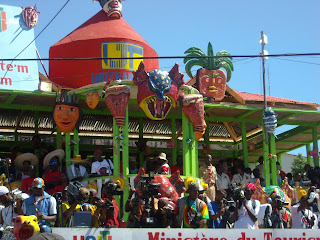 Nothing but the biggest celebration to hit the Catholic world each year, Kànaval is the last great splash before Lent begins. In
Haiti


 Our working hypothesis is that things creative in Haiti are usually
political or religious. Yes, that is a MINUSTAH man getting mauled by a tiger.
The team's excursion
The morning after we returned from Jacmel, we loaded our team into the "bus," asSharon Haiti U.S. along the Mexico
 Our "roommate": an intrepid hermit crab.
The next day we took the boat taxi back to Cap Haitian for Kànaval. To give you a sense of what this is like inPort-au-Prince
Returning home was bittersweet: we love to travel, but living out of a bag gets old after a week or so. Hello, garden! Hello, home cooking! We missed you.
Kànaval
 Nothing but the biggest celebration to hit the Catholic world each year, Kànaval is the last great splash before Lent begins. In


 Our working hypothesis is that things creative in Haiti are usually
political or religious. Yes, that is a MINUSTAH man getting mauled by a tiger.
The morning after we returned from Jacmel, we loaded our team into the "bus," as
11 hours after leaving Desarmes we arrived in Piedra Blanca, home base of Floresta, a reforestation program actually working on both halves of the island. They have had amazing success working with the Dominican government, which has made reforestation a national priority. (Tourism is booming, and tourists would much rather see trees than bare burnt earth and some cacti.) We toured eucalyptus and cacao forests, and also checked out Floresta’s agricultural work: oregano, cilantro, and pineapple fields.

Pineapple.

Jean, looking both studious and majestic.

Chocolate in the wild.
 Learning about organic fertilizer with Rafael, a Floresta agriculturalist.
Our last day was spent taking in the sights of
Fritzner screaming to Frantzo, “Look! a road over our heads!” as we went under an overpass.
Nahomie whispering, Mezanmi! (“Oh my gosh!”) as the gate lifted after we dropped in our toll. (Tolls!)
Total silence as we drove past a big TV billboard; they sat enraptured.
It was a little sad for us that things that are so routine for us (and are actually nearly outmoded – who doesn’t have EZ-Pass?) were so remarkable to them. We so admire the bravery and persistence of Haitians in just living, but feel frustrated that it has to be that way – but we’ll leave the complexities of development for another post.
We decided to hop off the bus in Port, as we had decided to use the 5-day Kànaval weekend to take the bus south to Les Cayes to visit a friend. At the last minute, we were made an offer we couldn't refuse. Kurt (our new Country Representative – hooray!) and his girlfriend Hillary were headed north to the beach at Labadee and to check out Kànaval in Okap. The huge advantages for us: we wouldn’t have to sit on buses for hours, we could check out a place we’ve heard is unmissably great, and they could drop us off at our doorstep afterwards. We're in.
The town of

The ethereal mosquito net in our hotel room. See the greenery
outside? And the fan in the corner? That's a little slice of heaven.
outside? And the fan in the corner? That's a little slice of heaven.
 Our "roommate": an intrepid hermit crab.
The next day we took the boat taxi back to Cap Haitian for Kànaval. To give you a sense of what this is like in
Returning home was bittersweet: we love to travel, but living out of a bag gets old after a week or so. Hello, garden! Hello, home cooking! We missed you.
Wednesday, January 21, 2009
Of jobs and interviews
Despite the current global financial crisis, MCC Dezam is hiring a new person to work on the reforestation team. We're specifically hiring a woman to even out the gender balance on our team, and Sharon and I were both pretty interested to see how the process would play out.
A few weeks ago we sat down as a team and wrote a list of criteria. Among other things, we wanted an agricultural technician with team spirit, creativity, flexibility, and skill in capacity-building. Asking the team to participate in this process was important, because hiring here is a difficult dance around nepotism. We received 9 applications from qualified individuals, all of whom were known by at least one of our coworkers. Through a secret-ballot scoring process with each person choosing their top three candidates, the team narrowed down the candidates to be interviewed to 2.
I was asked to sit in on the interviews this week, and was supposed to come up with a few of the questions. I did what every red-blooded American does when in need of information: I Googled "typical interview questions." Of course I found hundreds of the same old old standards everyone expects to hear on an interview. W e narrowed down our list to 18 questions, and each person on our interviewing committee scored the response with a 1-5 scale. I quickly realized these questions I think of as "standard" are not at all standard here. I chalk confused and evasive responses up to the fact that these questions really are weird unless you were raised in a Western culture:
Us: "Where do you see yourself in 5 years?"
Both candidates: [puzzled look]
Us: "Where do you want to be in your career or personal life in 5 years?"
Both candidates: "Working for MCC in Desarmes, of course."
I was reminded that this new position is most likely a life job for our new hire, as finding another decently-paying job will be difficult at best.
Us: "The average MCC day varies a lot. Do you feel like you can be flexible when it comes to work?"
Both candidates: "Flexible, flexible...can you define the word?"
After that, one candidate described her physical flexibility.
I wondered if fleksib is not actually a kreyol word, although Jean designed the question.
Us: "Tell me your strengths and weaknesses."
Candidate: "I have no weaknesses."
Not every culture is so open with admitting personal strengths and weakness as ours, I guess, and no one has coached them on how to list weaknesses that are really strengths.
Us: "What would you do if you had MCC work and a personal obligation at the same time? How would you handle that?"
Candidate: "I would wake up earlier."
Us: "No, we mean at the exact same time."
Candidate: "Like I said, I would wake up earlier."
Us: "What parts of this job do you look forward to more than others?"
Both candidates: "I look forward to everything equally. I have no work preferences."
Maybe they really do like it all.
Us: "If we hire you, what salary are you looking for?"
Both candidates: "I will accept whatever the good people at MCC deem as a good salary."
Like I said, there are not a lot of jobs out there, so who wants to be picky?
Afterwards, I asked our team what they preferred: the truth, or an answer they wanted to hear. For example, if I were being interviewed and I described a weakness, and another person said "I have no weaknesses," who would they think was a stronger candidate? The person with no weaknesses, of course. They wanted the candidates to be honest, but it's still hard to hear someone describe their weaknesses. That was kind of tough for me to hear, since I had the exact opposite response.
Overall, the process reminded us that economic development is difficult and uneven. If a person in a developing nation goes to school and earns a degree, there's no guarantee that the job market will be able to provide a position upon graduation. It's common for people here to have no work experience, although they graduated from agricultural school ten years ago. In the U.S., we're used to candidates seeking professional positions to have significant, relevant work experience. Here our new colleague will establish all her work experience with MCC Desarmes.
The interview committee decided that they want to hire the second candidate, who was actually a stronger interviewee. Sharon questioned whether the committee just like her more than the other person or whether they really like her (i.e., should we continue interviewing more people?). Each affirmed the choice - so we're inviting her to start work in March. We'll let you know how it goes.
Sunday, November 16, 2008
Weekend in the Lost Kingdom
A post in two movements: our weekend as we experienced it and a revelation of how little we actually know about Haitian culture.
We had heard that the island of Lagonav was a difficult place to visit, so we weren't that excited when we heard that we would be spending a long weekend there to visit a partner, Lekol Komunite Matenwa Pou Devlopman (LKMPD), or the Matenwa Community School. We've also heard that Lagonav residents are among the poorest in Haiti, that communities are regularly wiped out by flooding, deforestation was almost total, and that traversing the island is so difficult that no accurate map of the interior actually exists.
Despite what we'd heard (and finding out last-minute that we'd be staying not at the school but with a family, which can be quite hit-or-miss), we found at least one corner of the island to be a charmed place. In Matenwa, there's an active reforestation program (Step 1: convince the community), people there seem to be habituated to blans (they made jokes! they didn't ask for money!), and being in the mountains was a cool and refreshing change (long sleeves! easy sleeping!).
Our coworkers wanted to take a fly-boat, so we soared across the 20 miles between the Haitian mainland and Lagonav (despite the one return to the dock because the boat was overloaded by a few people). We also wondered about the setup on the next boat over, a sailboat with a Toyota at the prow, and an engine to assist:


We also got to visit an artisanal collective, where we watched a woman working on a silk painting that will be sold in Boston. There we spied the following note from one demanding Deirdre, who wants details:

And sunsets! Usually the sun sinks quietly behind a mountain in Dezam, a fact we didn't realize until we saw the likes of this:

However, we started to realize that we have only scratched the surface of Creole in the following exchanges:
Me: How many children does your mother have?
Our host: My mother has 8 children. I have 6 sisters.
Me: So you have 1 brother.
Host: No, I have 3 brothers.
Me, adding frantically in my head: ??
Host (to her youngest sister, who looks significantly younger than our host): Go get the the picture of all of us.
The pi ti fi, returning: Here you go.
The photo, taken at a wedding, is of newlyweds, another woman, and three young girls standing in front of the adults.
A pause.
Host: Oh, these kids are actually nieces.
Later:
Host's husband: How long have you been married?
Bryan: About 4 years.
Me: How about you?
Host's husband: I'm 29 years old.
Since you're only getting my translation, which reflects my confusion, you can be sure a major cause of us misunderstanding was our insufficient Creole! However, we also had several awkward moments like these:
Saturday morning, 7:15 a.m.:
Sister of 6-to-9 Siblings: Oh, did you want breakfast before your meeting? Are you leaving now?
Bryan & me, not sure if that's what we should request, but also not knowing where else to buy food: Um... in a little while...
Twenty-Nine: Oh, you're leaving after you eat, right?
Sister of 6-to-9: Okay.
She disappears for about 45 minutes, while we stand around furiously whispering about whether we should wait for food and show up late to our scheduled 8:00 a.m. meeting (and, of course, we had no cell reception on the mountain) or whether we should assume she's not making food for us and we should try to find food somewhere along the way. Around 8:15, though, breakfast was on the table and we were on our way shortly thereafter. (And the people we were meeting were even later than that, so no harm done.)
In reflecting on the weekend, we realized:
1. When we stay in the homes of other Americans, there is a lot of attention to arranging details. "What time will you wake up?" "Will you be eating breakfast here?" When I ask, "Do you have toilet paper?" the American answer isn't usually, "Oh, do you need that? I didn't have time to buy any."
2. In the U.S., a boat driver who felt that the boat was overloaded by 3 people wouldn't let 4 new people board, then return to the dock and make several other people get off.
3. There are probably good and logical reasons for the above.
We realized that we've been taking our own culture for granted: even after being here for over 3 months, we still assume that being American is being part of a neutral culture, that being American is the norm. Seeing ourselves through others' eyes ("Why don't they understand family structures? Why are they so obtuse about mealtimes?") reminds me that American culture, however globalized, is still totally foreign in many parts of the world. Fortunately.
And LKMPD? It actually turned out to be a wonderful school with progressive programming for each grade. We briefly visited classrooms, observed a hands-on lesson about seed germination, and checked out the school's garden. Spending 8 minutes on the following is well worth your time:
Monday, September 22, 2008
Robot spaghetti vs. river
When you were younger, did you love going through the car wash? I did. I loved the spraying of water, the huge "spaghetti" slapping the windows, more spraying of water and the huge blower, and a huge robot eye that looks at you and apparently drives your car for you. Pretty cool.
Well, Haiti tops that by a mile. Today after hiking, working, and attending a funeral I was asked to drive down a little road next to the nearby river. We pulled alongside it, and I was then directed to drive into the river. We parked in about two feet of flowing water. We all hopped out of the truck, my co-workers and I stripped down to our skivvies, and we washed the truck in the river. We washed all the mud off, and when finished someone produced a bar of soap--we lathered ourselves up, scrubbed up a bit, and jumped in to rinse off. We put our clothes back on, drove out of the river and back to the office clean as a whistle.
I think any kid would enjoy this car wash a bit more than the dancing spaghetti robot. I did.
Friday, September 19, 2008
Our first day of work (!)
After about two months of getting oriented to Haiti (and wildly disoriented), learning Creole, and meeting new people, we were finally able to put in an honest day's work.
We rose around 6:00 to meet with the administrative committee for one of the local tree nurseries. Alexis, Pancha (MCC's Connecting People Coordinator), Bryan, and I split up to visit three nurseries. Bryan and I actually went together with Michelet, a Haitian MCCer, on motorcycles and moto-taxis. He dropped us off in front of a school and took off, leaving us standing there with a few men from the committee. I tried to inquire about where he was headed, but instead of asking "Where is Michelet going?" I accidentally asked "Where is Michelet from?" --and got the appropriate response.
He eventually returned and the meeting commenced. I feel like our Creole is definitely improving: we were able to follow most of what was being said, although certainly not all. Little by little...
Because we waited around in the morning, I thought it would be wise to take my book along on the afternoon trip to see a ti foret, a little forest or tree garden. We again hopped on motorcycles and headed up a nearby mountain. However, the motorized portion of our trip ended in a hike down a ravine to a river and up the hillside before we reached the forest.
Franklin, one of the staunch members of the reforestation team, helped us cross the river, which was higher than normal and moving pretty fast. Pancha had a great time crossing:

You wouldn't know it to look at them, but these kids were having the time of their lives splashing around in the river. "Photo mwen! Photo me!" It seems that Haitians do not smile for photos if they can help it. Happens every time.

The hike was absolutely gorgeous, despite the bruise developing on my shoulder from carrying a 600-page book along...

Michelet showed us the little nursery he has:

And last but not least, here's the cheesy photo taken of the new Dezam MCCers for the environmental education newsletter, going out next week. Hopefully we don't scare away any potential friends.

Subscribe to:
Posts (Atom)