Yesterday, Sharon, I, Jean Remy, a friend of his who's name I forget, and a Belgian who has been working in Desarmes all went into the city. Our Belgian friend was going in to catch an evacuation flight back to Belgium and the rest of us were delivering sacks of rice and corn and other supplies for distribution and to find out what else we could do to help. We bought what rice we could in the local market - it turned out to be 4 sacks of rice and 1 sack of ground corn. We also took in 2 pickaxes and some new solar panels we had just bought for the Desarmes office but had yet to install them, so they went in too to help keep the batteries charged for the folks in Port.
Driving in was just as easy as normal - when we got to the last mountain crossing before descending into the valley where the city is, many large boulders had fallen onto the side of the road but were not blocking it. When we arrived in the Croix-de-Bouquet area, we sat in a traffic jam where a once-small makeshift bus station has now turned into a very large and crowded makeshift bus station for people trying to get out of the city. A small gas station had cars and trucks lined up trying to get fuel and ended up blocking the road. In this mess we came across two ladies who work in the MCC office in Port and their families, who have been living outside since their houses were destroyed on Tuesday. They were relieved to see us and asked for a ride out of the city - for about 15 people (!). We told them we would drop off the supplies and come get them on our way out. After 30 minutes or so we squeezed through the jam and found roads to be actually much less trafficky than normal.
Our normal road to get into Port (Delmas 33) was clear but was blocked by a few big MINUSTAH trucks so we had to make a detour to one of the main roads (Delmas). We passed close by the airport and saw helicopters and convoy trucks with what looked like search and rescue teams inside. Going up Delmas towards Petionville was eerie: people were walking up and down the street and traffic was almost nonexistent.
Everyone was either wearing a mask over their mouth and nose or had smeared a white cream under their nose (possibly to keep the scent of bodies away?). Many big buildings were flattened, and in a few places we saw heavy machinery working to remove rubble, most likely searching for survivors. We made our way to Petionville fairly quickly and dropped off our supplies . We saw Ben, Pancha and a friend named Carlito, holding up as best as possible. They had to leave soon after we got there so we started on our way back to Desarmes.
We made our way out of the city and found our group ready to head out to the countryside. Miraculously all 17 of us (I think, it was hard to get a head count) and luggage fit into the pickup, where we slowly (35 mph) made our way back to Desarmes, chugging up steep mountain roads in 2nd gear. The normally 2.5 hour trip was stretched to 4.5 hours but we all arrived safe and sound. This morning Jean-Remy loaded them up again for another long slow drive to a city in the central plateau called Hinche where they have family. Hopefully they all get there safely and Jean gets back without any problems; we still have no cell phone contact which makes everything more difficult, especially if vehicles break down.
It's obviously not the most dramatic story of Haiti right now, but we just wanted to share a little bit about what we're doing in all of this mess. With the arrival of MCC disaster-response folks and more organization and coordination with other NGOs we hope to figure out the best way for us to help.
Showing posts with label Dezam. Show all posts
Showing posts with label Dezam. Show all posts
Saturday, January 16, 2010

Sunday, January 10, 2010
Ironwomen.
Yesterday afternoon six of us intrepid MCC women set out for a 28-mile bike ride through the Artibonite Valley, from Mirabelais to Desarmes:
 I'm not really that short. It's just the wide-angle camera
lens and the tall Rachel standing next to me.
 Sometimes we stuck together, sometimes we spread out, but either
way we were the biggest spectacle to hit the Artibonite since Fet Dezam.
 Pancha won the award for Toughest Cyclist, considering the size and
weight of the brand-spankin'-new cargo bike she pedaled the whole way. (And good job on successfully completing Bike #2, Ben!)
 Margot was the second toughest with her long-tail
cargo bike...this cow was pretty interested in the whole affair.
 - or was the cow more interested in Esther's balancing act?
 The trip was challenging and definitely stretched us
(couldn't resist!), but was a great time.
These photos are courtesy of Ben Depp, and I'll add links to the photos other folks took as they become available online.
These photos are also proof that we returned safe and sound to Haiti. It was really helpful to have people around for the sixty-to-zero, Philadelphia-to-Dezam transition that was challenging last time. We're hopeful this bodes well for the next few months!
 I'm not really that short. It's just the wide-angle camera
lens and the tall Rachel standing next to me.
 Sometimes we stuck together, sometimes we spread out, but either
way we were the biggest spectacle to hit the Artibonite since Fet Dezam.
 Pancha won the award for Toughest Cyclist, considering the size and
weight of the brand-spankin'-new cargo bike she pedaled the whole way. (And good job on successfully completing Bike #2, Ben!)
 Margot was the second toughest with her long-tail
cargo bike...this cow was pretty interested in the whole affair.
 - or was the cow more interested in Esther's balancing act?
 The trip was challenging and definitely stretched us
(couldn't resist!), but was a great time.
These photos are also proof that we returned safe and sound to Haiti. It was really helpful to have people around for the sixty-to-zero, Philadelphia-to-Dezam transition that was challenging last time. We're hopeful this bodes well for the next few months!
Thursday, December 10, 2009
A brief meditation on food.
Our days were elemental, filled with nothing but eating and cooking. A food-oriented existence, asking questions only about taste. Scratch that: asking questions about the experience, wondering about what it’s like to make yogurt, curry, bagels, ginger ale. Fruit cobblers. Tomato soup. Chutney. Whole wheat rolls.
We had never felt more body, working directly for caloric intake. No salary-middleman. Hours of our lives, sacrificed on the altar of continued existence. How much effort it takes, how much work, to produce one loaf of bread, one pot of soup.
(Check it out: a grad student in England is working her way through one of the classic Mennonite cookbooks. Even though Extending the Table is not exclusively vegetarian, there are enough good recipes to make it enjoyable and recommendable.)
Our days were like menus, unrolling special after special. Variety was the spice of the kitchen, a way to log the passing seasons. Inundated by eggplant. Mangoes a-go-go. The knives were sharpened and the cast-iron in constant use.
The way to our stomachs was through our mouths, past tongues that professed nutrition but chose always taste. We slurped and sampled, becoming ingredient snobs. We accept only the freshest, the shapeliest, the most local. We felt cheated when foods were not in our market, when tastes available to others were denied us.We had never felt more body, working directly for caloric intake. No salary-middleman. Hours of our lives, sacrificed on the altar of continued existence. How much effort it takes, how much work, to produce one loaf of bread, one pot of soup.
(Check it out: a grad student in England is working her way through one of the classic Mennonite cookbooks. Even though Extending the Table is not exclusively vegetarian, there are enough good recipes to make it enjoyable and recommendable.)
Tuesday, December 8, 2009
What I imagine you imagine us doing
This morning we had a konbit grefaj, or grafting work day, to prepare 100 citrus trees for planting in the mountains. We hired four local experts to help, so even though I enjoy grafting I worked suuuper-slowly so that most of the seedlings would be grafted by people who really know what they're doing. (As an enjoyable bonus: citrus trees smell just like Fruit Loops.)


Thursday, December 3, 2009
Fet Dezam
I hope everyone has recovered from last night!
If you forgot, yesterday/today is Fet Dezam (Desarmes's founding anniversary, even though there was no mention of how old Desarmes is). It's almost like New Year's in the fact that the big day is the night before and the actual day of is a quieter day when people sleep in a bit and recover from a night of music, gambling, eating, and drinking.

 Actually, the party has been happening almost every night for the past 10 days or so. What this means is that the road gets blocked off and traffic gets diverted to side streets (read: dirt roads with no signs) while in the main road they make a little soccer field by painting lines on the pavement and making some tiny goals with no goalkeeper. This game is called ti kan - I think that means "little camp," but there must be another translation because that doesn't really make much sense. Anyhow, a stage was erected, speakers and stereo equipment were brought in, and generators and gas seemed to be in abundance.
If you forgot, yesterday/today is Fet Dezam (Desarmes's founding anniversary, even though there was no mention of how old Desarmes is). It's almost like New Year's in the fact that the big day is the night before and the actual day of is a quieter day when people sleep in a bit and recover from a night of music, gambling, eating, and drinking.


We went out last weekend with Matt and Gabriela and bought "juice": the options were breadfruit, manioc, banana (all with spaghetti mixed in, of course) and the best-sounding but unfortunately elusive papaya. Hot dogs were on the grills, and snacks were everywhere - patè, marinad, banan peze, and grillo (hot pockets, fried dough, smashed fried plantain, and fried/grilled meat). There were also many tables selling klerin (raw rum, about 78% alcohol) mixed with juice or milk. We tried to watch the ti kan match, but unless you were right at the fence it was very difficult to see over the heads of the other spectators.
Last night we went back out around 7pm since it was the Big Night. (Trust me, Fet Dezam is bigger than Christmas: "When's Christmas again? Oh right,the 25th.") The sound was incredible! There was also a wake with a generator (= loud music) and the Vodou version of the party (= drumming and dancing and singing). The main stage featured a DJ spinning Haitian rap and konpa (= people standing around hoping to watch other people dance but no one actually dancing). We walked around for a little while, and then went to Jean-Remy and Gerda's store and hung out for a few hours eating fried food and watching vehicles trying to follow the detour and make their way through the crowd. We called it a night around 9pm, ate leftover soup, read, and went to bed with the music thumping us to sleep.
Today the Catholic church celebrates the anniversary of some St. Francis (not Assisi - that was clear - but I'm not sure which saint this is. Maybe Xavier?). That celebration features about 12 priests from all over, a lot of food, and a 4-hour service. We checked it out but couldn't find a seat, so we didn't stay very long.
Last night we went back out around 7pm since it was the Big Night. (Trust me, Fet Dezam is bigger than Christmas: "When's Christmas again? Oh right,the 25th.") The sound was incredible! There was also a wake with a generator (= loud music) and the Vodou version of the party (= drumming and dancing and singing). The main stage featured a DJ spinning Haitian rap and konpa (= people standing around hoping to watch other people dance but no one actually dancing). We walked around for a little while, and then went to Jean-Remy and Gerda's store and hung out for a few hours eating fried food and watching vehicles trying to follow the detour and make their way through the crowd. We called it a night around 9pm, ate leftover soup, read, and went to bed with the music thumping us to sleep.
Today the Catholic church celebrates the anniversary of some St. Francis (not Assisi - that was clear - but I'm not sure which saint this is. Maybe Xavier?). That celebration features about 12 priests from all over, a lot of food, and a 4-hour service. We checked it out but couldn't find a seat, so we didn't stay very long.
Maybe I should just think of Fet Dezam as preparation for New Year's Eve as I am getting out of the habit of staying awake past midnight - but that's what Red Bull is for, right?
Tuesday, December 1, 2009
Can someone please do this? Pretty please?
I've noticed how "process" blogs and books are all the rage now, like The Year of Living Biblically, Julie & Julia, or Simply Me: A Year of Eating Locally, Mindfully, Simply (highly recommended, by the way).
I would LOVE to read a blog tracking someone's page-by-page progress through the projects in this amazing 1981 Reader's Digest publication:*
 Basically (get it?), it covers a wide array of survivalist and hobby skills, from organizing your garden to candlemaking to to basketry to the fine art of scrimshaw.
Our office copy here is a little beat up, but it still asks helpful questions...
 shows you how to beautify your environment...


But the book also throws down a few challenges:
 Well?
Well?
 - with proper surveyor's tools, of course.

Now there's nothing stopping you from having your dream barn!
 And as if all this wasn't enough, it even tells you how to harness the energy of the sun.
I would LOVE to read a blog tracking someone's page-by-page progress through the projects in this amazing 1981 Reader's Digest publication:*
 Basically (get it?), it covers a wide array of survivalist and hobby skills, from organizing your garden to candlemaking to to basketry to the fine art of scrimshaw.

and have fun while working:

You can even learn how to look great - because "For Well-Dressed Hikers, Fashions Never Change":

But the book also throws down a few challenges:
 Well?
Well? - with proper surveyor's tools, of course.
Now there's nothing stopping you from having your dream barn!
 And as if all this wasn't enough, it even tells you how to harness the energy of the sun.
The person blogging through this book would be one of the most inefficient people ever, but man alive. You could do anything.
* I can't start the Back-to-Basics blog because I'm in the midst of writing My Year[s] of Being a Foreigner in Rural Haiti, aka this blog.
* I can't start the Back-to-Basics blog because I'm in the midst of writing My Year[s] of Being a Foreigner in Rural Haiti, aka this blog.
Sunday, November 29, 2009
worms
One of the things we brought back with us from our trip to MPP the week before last was about a pound of red worms. I've been thinking about vermicomposting for quite a while now, but the thought of buying worms on the internet and having them shipped in the mail just seemed too excessive. So when presented with an organization that has an abundance of them and will give you a bucketful of worms for about $15 we figured...why not? We split the cost with the Depps, so half went off to Port to be city worms and the other half are here with us in Dezam.

MPP fed their worms a steady diet of horse droppings and then used the worms to feed their chickens. I've heard a lot about how worms can eat a lot of kitchen waste. We cook with vegetables almost every day and produce a fair amount of organic waste. Despite our best efforts, our other methods of composting haven't been able to keep up with the amount we produce. So I put the worms into a smallish Tupperware container (hopefully temporary, as I have read they like lots of room to roam around - they like to be able to escape hot spots or excess water or dry spots or whatever they don't like at the moment). After a week of feeding them cabbage, beets, bananas, and tomatoes they still prefer horse droppings (which I have been, um, gathering from the road).
I'm not sure if I should try to wean them from their addiction or just let them indulge in their sweet tooth as there is plenty of horse poo around for them to chow down on. The only problem is that our compost predicament gets no help, but now we can have a bunch of nutrient-rich fertilizer for our garden.
Well, next time you need a laugh you can imagine me walking the streets of Dezam with a bucket and little shovel looking for horse droppings - when people ask me what I'm doing I tell them I'm looking for food for my worms.
Another funny/sad thing: I was just informed that Haitians generally hate worms and will kill them when they see them in the garden because they look similar to snakes. Really? Isn't that a bit excessive? I heard this a few days after I heard that farmers in the area are killing honey bees because they don't like them. I asked them why and explained that without pollinators every garden in the area would be in a lot of trouble. Response: smiles and nods. A little piece of my hope for environmental recovery was lost.
Anyway, here's to living bees, thriving worms, and a Haiti developing into the lush tropical wonderland it could be.

MPP fed their worms a steady diet of horse droppings and then used the worms to feed their chickens. I've heard a lot about how worms can eat a lot of kitchen waste. We cook with vegetables almost every day and produce a fair amount of organic waste. Despite our best efforts, our other methods of composting haven't been able to keep up with the amount we produce. So I put the worms into a smallish Tupperware container (hopefully temporary, as I have read they like lots of room to roam around - they like to be able to escape hot spots or excess water or dry spots or whatever they don't like at the moment). After a week of feeding them cabbage, beets, bananas, and tomatoes they still prefer horse droppings (which I have been, um, gathering from the road).
I'm not sure if I should try to wean them from their addiction or just let them indulge in their sweet tooth as there is plenty of horse poo around for them to chow down on. The only problem is that our compost predicament gets no help, but now we can have a bunch of nutrient-rich fertilizer for our garden.
Well, next time you need a laugh you can imagine me walking the streets of Dezam with a bucket and little shovel looking for horse droppings - when people ask me what I'm doing I tell them I'm looking for food for my worms.
Another funny/sad thing: I was just informed that Haitians generally hate worms and will kill them when they see them in the garden because they look similar to snakes. Really? Isn't that a bit excessive? I heard this a few days after I heard that farmers in the area are killing honey bees because they don't like them. I asked them why and explained that without pollinators every garden in the area would be in a lot of trouble. Response: smiles and nods. A little piece of my hope for environmental recovery was lost.
Anyway, here's to living bees, thriving worms, and a Haiti developing into the lush tropical wonderland it could be.

Thursday, November 26, 2009
A honey of a day.
Happy Thanksgiving!
No, it's not a holiday in Haiti, but it's hard to shake a day like that from your psyche after celebrating it for a few decades. Say hi to a turkey for us.
Anyway, the most exciting thing happening this week is that the bees who had been living in MCC's storage shed for the past six weeks were finally moved to their own home by Miguel, a local miel-man. (The other beekeeper in Dezam is named Millefleur. Amazing.) Miguel got stung about 30 times, but we got to enjoy the fruits of his labor:
 (I will admit that the little dead bee-grubs you can see there are not that appetizing. I think I'll stick with our refillable bottle of cleaned honey.)
 When was the last time you chomped down on a sweet piece of fresh beeswax? It tastes better than those weird little candies that still linger in some grocery stores, but the mouth-feel is similar.
Bon appétit!
No, it's not a holiday in Haiti, but it's hard to shake a day like that from your psyche after celebrating it for a few decades. Say hi to a turkey for us.
Anyway, the most exciting thing happening this week is that the bees who had been living in MCC's storage shed for the past six weeks were finally moved to their own home by Miguel, a local miel-man. (The other beekeeper in Dezam is named Millefleur. Amazing.) Miguel got stung about 30 times, but we got to enjoy the fruits of his labor:
 (I will admit that the little dead bee-grubs you can see there are not that appetizing. I think I'll stick with our refillable bottle of cleaned honey.)
 When was the last time you chomped down on a sweet piece of fresh beeswax? It tastes better than those weird little candies that still linger in some grocery stores, but the mouth-feel is similar.
Bon appétit!
Monday, November 23, 2009
A Tale of Two Papayas
Last Thursday, the environmental education team trekked to the Central Plateau to visit Mouvman Peyizan Papay, a 36-year-old peasants' movements in the town of Papaye. We are planning to bring all the teachers in our program here in December, so we came to check out MPP's work and make arrangements for our excursion with their staff.
We started with a tour of their experimental gardens, learning about their soil mixture, irrigation systems, and permaculture strategies:

Their small-animal husbandry addresses the problem of elvaj lib (in which goats and other animals roam freely and eat what they like from various gardens). These goats are fed from the farm - the woody stems they don't eat are later used to build erosion barricades on sloped land.

Tire gardens protect plans from ranging chickens and provide a more controlled environment for managing the soil:

The mandala garden was bursting with garlic chives, cabbage, chard, peppers, and spinach:

This horse was not technically part of our tour, but isn't this one of the greatest saddles you've ever seen?
 I think our teachers are going to have a terrific time.
The second papaya is a little closer to home. Our neighbor/landlord let us know that she disapproves of our rooftop garden:
"Why are you growing those papayas? You know they won't do anything."
"Yes, but it's more for fun [and shade] than anything..."
Pilgrim's Progress-fashion, we've nicknamed her Madam Pa Renmen (Mrs. Doesn't-like) because of her many complaints. If she can see us do it, she doesn't like it. It's hard to take her seriously after a while. This is a situation we're trying to improve with a spirit of humility and cooperativeness, but in the meantime I've realized that "love your enemies" and "love your neighbors" are basically the same commandment.
We started with a tour of their experimental gardens, learning about their soil mixture, irrigation systems, and permaculture strategies:

Their small-animal husbandry addresses the problem of elvaj lib (in which goats and other animals roam freely and eat what they like from various gardens). These goats are fed from the farm - the woody stems they don't eat are later used to build erosion barricades on sloped land.

Tire gardens protect plans from ranging chickens and provide a more controlled environment for managing the soil:

The mandala garden was bursting with garlic chives, cabbage, chard, peppers, and spinach:
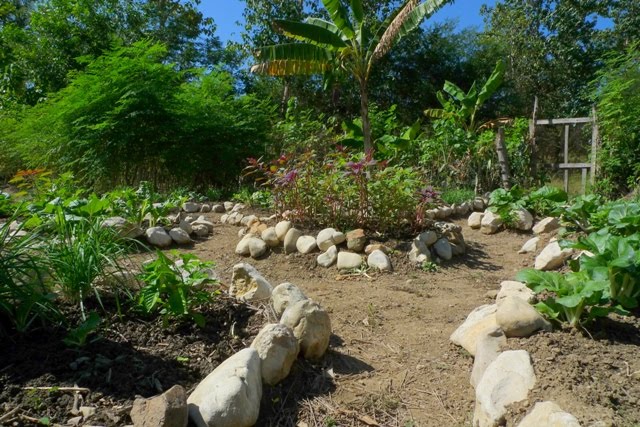
This horse was not technically part of our tour, but isn't this one of the greatest saddles you've ever seen?
 I think our teachers are going to have a terrific time.
The second papaya is a little closer to home. Our neighbor/landlord let us know that she disapproves of our rooftop garden:
"Why are you growing those papayas? You know they won't do anything."
"Yes, but it's more for fun [and shade] than anything..."
Pilgrim's Progress-fashion, we've nicknamed her Madam Pa Renmen (Mrs. Doesn't-like) because of her many complaints. If she can see us do it, she doesn't like it. It's hard to take her seriously after a while. This is a situation we're trying to improve with a spirit of humility and cooperativeness, but in the meantime I've realized that "love your enemies" and "love your neighbors" are basically the same commandment.
Wednesday, November 18, 2009
Happy November 18!
What, you didn't know today is Fèt Batay Vètyè, the day that commemorates the last battle of the Haitian Revolution? Time to brush up on some Haitian history:
- On this day in 1803, Jean-Jacques Dessalines led Haitian forces to victory against the French at their fort in Vertières, near Cap-Haitian in the north.
- Because of this blow to the French forces, the Haitians were able to declare independence a mere six weeks later: Haitian Independence Day is celebrated on January 1 and is the biggest holiday of the year.
- Whether Haitians actually achieved their independence in 1804 appears to be a matter of ongoing debate. In 2005 Fondasyon 30 Septanm argued that
"Just as Napoleon's Army in 1803 was a multinational army with soldiers from many European countries, so today's MINUSTAH, the UN army, is composed of soldiers from Jordan, Chile, the US, France, Canada and 15 other countries -- with the same objective, to crush the aspirations of the Haitian people and re-establish colonial rule. The Haitian people have the opposite objective -- to complete the liberation begun on November 18, 1803. That's why Haiti Liberation Day is so relevant today, and why we are encouraging demonstrations, teach-ins or other activities on or around November 18th."
I'm not totally sure I agree with this perspective, but MINUSTAH's mandate in Haiti is one that surely merits attention and further questions.
- As far as we can tell, no one in Dezam is doing much to celebrate, other than taking the day off. We are marking the occasion by sleeping in, making lots of yummy food, and catching up on various odds jobs.
- More productively, Amnesty International is honoring the spirit of independence by launching a campaign pressing the Haitian government to end child slavery and protect the rights of child domestic workers throughout the country. The restavek system is a major human rights issue in Haiti - let's hope this campaign helps make a difference. (Isn't it almost 2010? Shouldn't we all be alarmed that this type of problem still exists in the world?)
- On this day in 1803, Jean-Jacques Dessalines led Haitian forces to victory against the French at their fort in Vertières, near Cap-Haitian in the north.
- Because of this blow to the French forces, the Haitians were able to declare independence a mere six weeks later: Haitian Independence Day is celebrated on January 1 and is the biggest holiday of the year.
- Whether Haitians actually achieved their independence in 1804 appears to be a matter of ongoing debate. In 2005 Fondasyon 30 Septanm argued that
"Just as Napoleon's Army in 1803 was a multinational army with soldiers from many European countries, so today's MINUSTAH, the UN army, is composed of soldiers from Jordan, Chile, the US, France, Canada and 15 other countries -- with the same objective, to crush the aspirations of the Haitian people and re-establish colonial rule. The Haitian people have the opposite objective -- to complete the liberation begun on November 18, 1803. That's why Haiti Liberation Day is so relevant today, and why we are encouraging demonstrations, teach-ins or other activities on or around November 18th."
I'm not totally sure I agree with this perspective, but MINUSTAH's mandate in Haiti is one that surely merits attention and further questions.
- As far as we can tell, no one in Dezam is doing much to celebrate, other than taking the day off. We are marking the occasion by sleeping in, making lots of yummy food, and catching up on various odds jobs.
- More productively, Amnesty International is honoring the spirit of independence by launching a campaign pressing the Haitian government to end child slavery and protect the rights of child domestic workers throughout the country. The restavek system is a major human rights issue in Haiti - let's hope this campaign helps make a difference. (Isn't it almost 2010? Shouldn't we all be alarmed that this type of problem still exists in the world?)
Monday, November 16, 2009
More on Vodou
We regularly listen to Speaking of Faith on NPR. I went to the website trying to find more information about a recent guest on their show and found this story on Haitian Vodou and a link to a photographer who has visited ceremonies in New York. I'm not sure if we posted these links before but they're worth a look.
The other thing I've been thinking about this week is an interview with an author who asked: wherever you are in your faith, and whichever faith you choose to practice, how do you treat your wife? your friends? strangers? Are you a pleasant person to be around? Or in other words, do unto others as you want them to do unto you. So, treat people kindly, with respect, patience, and genuine interest.
Sometimes here in Haiti I feel like I am an unpleasant person to be around. I complain about not having a toilet and electricity, I bicker with the neighbors/landlord, I walk past countless strangers everyday who are asking for help from me directly. So where do I go from here? I've thought about meditation as a way to relax, focus on God, and possibly improve my outward disposition towards others. Maybe that will help, who knows, but whether or not I agree with author Frank Schaeffer I think he poses a valid question that deserves further reflection if I want to consider myself a Christian.
The other thing I've been thinking about this week is an interview with an author who asked: wherever you are in your faith, and whichever faith you choose to practice, how do you treat your wife? your friends? strangers? Are you a pleasant person to be around? Or in other words, do unto others as you want them to do unto you. So, treat people kindly, with respect, patience, and genuine interest.
Sometimes here in Haiti I feel like I am an unpleasant person to be around. I complain about not having a toilet and electricity, I bicker with the neighbors/landlord, I walk past countless strangers everyday who are asking for help from me directly. So where do I go from here? I've thought about meditation as a way to relax, focus on God, and possibly improve my outward disposition towards others. Maybe that will help, who knows, but whether or not I agree with author Frank Schaeffer I think he poses a valid question that deserves further reflection if I want to consider myself a Christian.
Thursday, November 12, 2009
Too many motorcycles? Or, in search of a silver bullet.
Each week during our team meeting, we each have the chance to share news: local, national, and international. As TV is almost nonexistent and the internet is available only to some, the local radio is Haiti's #1 news source. Yesterday we talked about the new prime minister, the local soccer team, and then one story topped them all. Frantzo told us about a recent study that has at last figured out what Haiti's development problems are: motorcycles.
According to this study, there are 4 million made-in-China motorcycles in Haiti, and the purchase of one of these apparently causes the new owner to drop out of school and stop doing anything that contributes to sustainable development. So if all we have to do to "save Haiti" is get rid of all these motorcycles, what are we waiting for?
"Really, Frantzo? You have a motorcycle and you do development work."
"Well, it's not people that work for an organization, but private people."
Our team finally concluded:
- 4 million motorcycles would mean every other Haitian owns one. In Michelet's hometown of Valere, to take one example, he estimates there are 5 motorcycles and approximately 30,000 people. Looks like Valere is short by 14,955 motorcycles.
- Most motorcycles are not private vehicles but are small businesses - the owners "make traffic" (it's so great that that's the verb) by operating their bikes as moto-taxis. So if there are no moto-taxis that would mean even fewer jobs, right? They are indeed dangerous, but there are already a lot of young men hanging out with nothing to do, and taking away all the motos in Dezam would create another sort of crisis. I'm all for advocating bicycles over motos but putting blame on motos as a stumbling block to development seems like a unliklely culprit.
- Moto-taxis make it much easier to take goods to market. With a motorcycle you can carry drums of oil, sacks of produce, 4 or 5 people, and we once saw someone carrying another motorcycle.
- Yes, it is bad that so much Haitian money ends up in the hands of Chinese manufacturers, but that's a problem faced by more countries than this one. Hey, maybe the solution is to start a business manufacturing Haitian motorcycles! Anybody up for a new development project?
As a final note, as I was searching for verification of this story I came across a new website: www.wehaitians.com, which seems to be a news source for Haitian diaspora. Here I learned President Preval is again a married man. Congrats.
According to this study, there are 4 million made-in-China motorcycles in Haiti, and the purchase of one of these apparently causes the new owner to drop out of school and stop doing anything that contributes to sustainable development. So if all we have to do to "save Haiti" is get rid of all these motorcycles, what are we waiting for?
"Really, Frantzo? You have a motorcycle and you do development work."
"Well, it's not people that work for an organization, but private people."
Our team finally concluded:
- 4 million motorcycles would mean every other Haitian owns one. In Michelet's hometown of Valere, to take one example, he estimates there are 5 motorcycles and approximately 30,000 people. Looks like Valere is short by 14,955 motorcycles.
- Most motorcycles are not private vehicles but are small businesses - the owners "make traffic" (it's so great that that's the verb) by operating their bikes as moto-taxis. So if there are no moto-taxis that would mean even fewer jobs, right? They are indeed dangerous, but there are already a lot of young men hanging out with nothing to do, and taking away all the motos in Dezam would create another sort of crisis. I'm all for advocating bicycles over motos but putting blame on motos as a stumbling block to development seems like a unliklely culprit.
- Moto-taxis make it much easier to take goods to market. With a motorcycle you can carry drums of oil, sacks of produce, 4 or 5 people, and we once saw someone carrying another motorcycle.
- Yes, it is bad that so much Haitian money ends up in the hands of Chinese manufacturers, but that's a problem faced by more countries than this one. Hey, maybe the solution is to start a business manufacturing Haitian motorcycles! Anybody up for a new development project?
As a final note, as I was searching for verification of this story I came across a new website: www.wehaitians.com, which seems to be a news source for Haitian diaspora. Here I learned President Preval is again a married man. Congrats.
Tuesday, November 10, 2009
It's that season again...
...for Vodou, that is. In the Artibonite Valley we hear the night-drums and see the assorted odd bits of Vodouiana from about Halloween to Easter. Last year we nearly stumbled into a torchlit cow-sacrifice processional as we locked up the office gate one night, and I'm hoping to avoid that experience this year.
Not only has the subject of Vodou recently appeared here and here, it came up in conversation yesterday with our teammates Frantzo and Fritzner. As we returned from a meeting with a group in the next town over, Bryan accidentally ran over something we've come to recognize as clearly Vodou: a calabash bowl with a candle in it sitting in an intersection. Everyone hastily reassured Bryan that because it was the truck that broke the bowl, and the truck is not alive, it would be fine because magic can't affect machines.
Well!
me: So if trucks represent technology, can we say that technology is more powerful than Vodou magic?
Frantzo: Yes! If everyone had technology, Vodou would be finished. The more technologically-advanced people become, the less they rely on Vodou.
Fritzner: Yes, Vodou definitely gets in the way of development. If it helped, then Haiti and Africa would be the most developed nations on earth.
(So - can we think of technological development as a form of evangelism?)
It's really interesting to me to think of the role that people expect religion to play in their lives - F & F seem to think that Vodou fulfills some need that is more apparent when physical needs are not being met, but once a person is able to meet basic needs the role of Vodou in the life of that person drastically shrinks.
The Artibonite Valley is known as the Scary Center of Vodou by people in other parts of Haiti, but it seems to me that what F & F point out is true. People turn to Vodou when there's an illness the local hospital can't address. They turn to Vodou when they feel like someone is taking unfair advantage of a situation. They use Vodou to access power that feels otherwise remote.
Is this an indictment of the Christian church? Of the Haitian government?
Dismissing Vodou as a religion of the peasants is sort of akin to throwing out the cultural baby with the ceremonial bathwater, since Vodou has long been the primary way that Haitians have addressed questions of spirituality. I think it's important to take that means of expression seriously and pay attention to what it can tell us about a perception of God that is unique to this culture.
I know a lot of evangelical Americans in particular think that Haiti is the way it is because of the practice of Vodou, but it might turn out to be just the opposite.
(By the way, be sure to check out the American Museum of Natural History's archived exhibition, The Sacred Arts of Haitian Vodou. It provides a nice overview that covers many aspects of the religion.)
Not only has the subject of Vodou recently appeared here and here, it came up in conversation yesterday with our teammates Frantzo and Fritzner. As we returned from a meeting with a group in the next town over, Bryan accidentally ran over something we've come to recognize as clearly Vodou: a calabash bowl with a candle in it sitting in an intersection. Everyone hastily reassured Bryan that because it was the truck that broke the bowl, and the truck is not alive, it would be fine because magic can't affect machines.
Well!
me: So if trucks represent technology, can we say that technology is more powerful than Vodou magic?
Frantzo: Yes! If everyone had technology, Vodou would be finished. The more technologically-advanced people become, the less they rely on Vodou.
Fritzner: Yes, Vodou definitely gets in the way of development. If it helped, then Haiti and Africa would be the most developed nations on earth.
(So - can we think of technological development as a form of evangelism?)
It's really interesting to me to think of the role that people expect religion to play in their lives - F & F seem to think that Vodou fulfills some need that is more apparent when physical needs are not being met, but once a person is able to meet basic needs the role of Vodou in the life of that person drastically shrinks.
The Artibonite Valley is known as the Scary Center of Vodou by people in other parts of Haiti, but it seems to me that what F & F point out is true. People turn to Vodou when there's an illness the local hospital can't address. They turn to Vodou when they feel like someone is taking unfair advantage of a situation. They use Vodou to access power that feels otherwise remote.
Is this an indictment of the Christian church? Of the Haitian government?
Dismissing Vodou as a religion of the peasants is sort of akin to throwing out the cultural baby with the ceremonial bathwater, since Vodou has long been the primary way that Haitians have addressed questions of spirituality. I think it's important to take that means of expression seriously and pay attention to what it can tell us about a perception of God that is unique to this culture.
I know a lot of evangelical Americans in particular think that Haiti is the way it is because of the practice of Vodou, but it might turn out to be just the opposite.
(By the way, be sure to check out the American Museum of Natural History's archived exhibition, The Sacred Arts of Haitian Vodou. It provides a nice overview that covers many aspects of the religion.)
Sunday, October 25, 2009
Quotidian observations.
After being in Haiti over a year now, I'm sure everyone has noticed the decreasing frequency of blog posts as tree frogs in the kitchen, revival services at 3am, and poverty have (for better or worse) become normal. So here are a few things that have caught my attention - in no particular order - over the last few weeks since we've been back.
1. We use a lot of bleach. Every time we wash dishes we use a bleachy rinsewater which has led to some sad clothing mishaps - white splotches if you're lucky and holes if you aren't.
2. We use a lot of matches. We light a new match every time we use the stove, candles, oil lamps, incense, and mosquito coils. I even have a preferred brand of matches which happen to be made in Gonaives, Haiti. These little suckers are nice.
3. Coming to the office one day we saw 4 or 5 young guys sitting around a laptop right outside of our driveway, pretty obviously filching our wireless signal. When I came into the office and mentioned this, everyone else thought they were just enjoying the nice shady patch in the road. Needless to say, I put a password on the wireless signal as we do pay for a meager 400 MB per day and a couple of young men on the internet can eat that up pretty fast.
4. Trying to get through a blocked intersection in Port-au-Prince, I stopped to let an old lady with a wheelbarrow pass through the mess of cars. The guy next to me decided to hit her wheelbarrow instead. She simply straightened it up and rushed away from the driver without saying a word.
5. I got a new pair of shoe/slipper things when we were back in the U.S. and they are the most amazing thing in the world, especially for Haiti living. Sanuk.
6. A pretty tough virus is going around Haiti. Half of the Port-au-Prince staff was hit by it and one of our team members in Desarmes was out for a week with it. Despite the fact that he is a very devout 7th Day Adventist, he believes it was an evil spirit that overtook him in the night.
7. Last week Sharon and I hiked about 2 hours into the countryside to visit a school. The trail had us following a river for awhile, then hiking up a mountain to go around a narrow, cavernous section of the river, and then back down to the river until we arrived at the school. On our way back we decided to walk back along the river the whole way and discovered a new waterfall and pool, and another new waterfall that we had to bushwhack to get around as we didn't want to jump into an unknown pool of water. The big question was answered though: "Is it faster to take the mountain path or the river?" Answer: The mountain. But the river is prettier.
8. Progress on the cargo-bike welding project is happening. Almost everything is welded; we just need to get a longer chain, brake, and derailleur cables. Photos forthcoming.
9. I sat down on a hammock and instead of falling into its pocket I fell off and whacked my head.
10. Work is somewhat slow during this season so I’ve read a few books: The Power of One, and I've just finished The Brothers K (700+ pages).
11. Desarmes is still really hot.
12. Driving to the MCC office in PaP I accidentally snagged a drooping power line on the metal cage covering the bed of the pickup. Oops. A passerby kindly pulled it off for me.
13. Ben and Alexis got a new place with two bedrooms so now we can sleep indoors when we visit the city. Bonus.
14. I saw one of those 3-wheeled motorcycles with 2 wheels in the front and one in the back. Hmmm, these displays of wealth always seem odd - I know I'm a wealthy person here in comparison but then you see one of these and you know there's lots of money here, somewhere. Check out the MSRP.
15. Our rooftop garden is a thirsty, thirsty place, which is not much fun. See point 11.
16. I try to keep up with U.S. news, and as someone who couldn’t afford health insurance for a while despite having a full-time job, I’m all for government-sponsored healthcare.It just seems like everyone that is lucky enough to have insurance is against the rest of us getting it. Really, if I break my leg the day I return to the U.S. I will kill our savings and drown us in debt. Yay!
17. From the padlock that falls apart every time you open (on the gate to our yard) to the one that no longer will open (on one of our trucks), we see all kinds of padlocks here.
18. Utensils: Sharon and I have a favorite spoon and a favorite fork. You know you’re loved when your spouse gives you “the” spoon or “the” fork.
19. Despite having carrots and potatoes at the local market and a usual healthy cooked-from-scratch lifestyle, we keep a stash of Ramen noodles in the house for all of those “I don’t feel like cooking” moments. Well, Everybody Loves Ramen...
20. We miss Josh and Marylynn and their visits to Desarmes and all the good talks about God and development. Oh, and watching movies together.
21. We got scolded by our landlords/neighbors about locking the gate too tightly and not locking it often enough. Their request: lock it every time you go in or out no matter who is home - just don’t lock it too tight. (Update: now we're not supposed to lock it if they're home. I might need a wallet-sized cheat sheet on this.)
22. Fireflies are amazing. They're in the house at night and their cool green abdomens float above us as we lay in bed.Unlike ‘merican fireflies, they don’t flash; they just light up and fly around.
23. I am on an all-things-bicycle reading spree right now. It's kind of boring reading when I can’t actually get my hands on the stuff, but I’ve just finished The Art of Wheelbuilding by Gerd Shraner, and now am reading Tim Paterek’s bicycle building manual. Maybe Barnett’s Bicycle Repair manual will be next.
1. We use a lot of bleach. Every time we wash dishes we use a bleachy rinsewater which has led to some sad clothing mishaps - white splotches if you're lucky and holes if you aren't.
2. We use a lot of matches. We light a new match every time we use the stove, candles, oil lamps, incense, and mosquito coils. I even have a preferred brand of matches which happen to be made in Gonaives, Haiti. These little suckers are nice.
3. Coming to the office one day we saw 4 or 5 young guys sitting around a laptop right outside of our driveway, pretty obviously filching our wireless signal. When I came into the office and mentioned this, everyone else thought they were just enjoying the nice shady patch in the road. Needless to say, I put a password on the wireless signal as we do pay for a meager 400 MB per day and a couple of young men on the internet can eat that up pretty fast.
4. Trying to get through a blocked intersection in Port-au-Prince, I stopped to let an old lady with a wheelbarrow pass through the mess of cars. The guy next to me decided to hit her wheelbarrow instead. She simply straightened it up and rushed away from the driver without saying a word.
5. I got a new pair of shoe/slipper things when we were back in the U.S. and they are the most amazing thing in the world, especially for Haiti living. Sanuk.
6. A pretty tough virus is going around Haiti. Half of the Port-au-Prince staff was hit by it and one of our team members in Desarmes was out for a week with it. Despite the fact that he is a very devout 7th Day Adventist, he believes it was an evil spirit that overtook him in the night.
7. Last week Sharon and I hiked about 2 hours into the countryside to visit a school. The trail had us following a river for awhile, then hiking up a mountain to go around a narrow, cavernous section of the river, and then back down to the river until we arrived at the school. On our way back we decided to walk back along the river the whole way and discovered a new waterfall and pool, and another new waterfall that we had to bushwhack to get around as we didn't want to jump into an unknown pool of water. The big question was answered though: "Is it faster to take the mountain path or the river?" Answer: The mountain. But the river is prettier.
8. Progress on the cargo-bike welding project is happening. Almost everything is welded; we just need to get a longer chain, brake, and derailleur cables. Photos forthcoming.
9. I sat down on a hammock and instead of falling into its pocket I fell off and whacked my head.
10. Work is somewhat slow during this season so I’ve read a few books: The Power of One, and I've just finished The Brothers K (700+ pages).
11. Desarmes is still really hot.
12. Driving to the MCC office in PaP I accidentally snagged a drooping power line on the metal cage covering the bed of the pickup. Oops. A passerby kindly pulled it off for me.
13. Ben and Alexis got a new place with two bedrooms so now we can sleep indoors when we visit the city. Bonus.
14. I saw one of those 3-wheeled motorcycles with 2 wheels in the front and one in the back. Hmmm, these displays of wealth always seem odd - I know I'm a wealthy person here in comparison but then you see one of these and you know there's lots of money here, somewhere. Check out the MSRP.
15. Our rooftop garden is a thirsty, thirsty place, which is not much fun. See point 11.
16. I try to keep up with U.S. news, and as someone who couldn’t afford health insurance for a while despite having a full-time job, I’m all for government-sponsored healthcare.It just seems like everyone that is lucky enough to have insurance is against the rest of us getting it. Really, if I break my leg the day I return to the U.S. I will kill our savings and drown us in debt. Yay!
17. From the padlock that falls apart every time you open (on the gate to our yard) to the one that no longer will open (on one of our trucks), we see all kinds of padlocks here.
18. Utensils: Sharon and I have a favorite spoon and a favorite fork. You know you’re loved when your spouse gives you “the” spoon or “the” fork.
19. Despite having carrots and potatoes at the local market and a usual healthy cooked-from-scratch lifestyle, we keep a stash of Ramen noodles in the house for all of those “I don’t feel like cooking” moments. Well, Everybody Loves Ramen...
20. We miss Josh and Marylynn and their visits to Desarmes and all the good talks about God and development. Oh, and watching movies together.
21. We got scolded by our landlords/neighbors about locking the gate too tightly and not locking it often enough. Their request: lock it every time you go in or out no matter who is home - just don’t lock it too tight. (Update: now we're not supposed to lock it if they're home. I might need a wallet-sized cheat sheet on this.)
22. Fireflies are amazing. They're in the house at night and their cool green abdomens float above us as we lay in bed.Unlike ‘merican fireflies, they don’t flash; they just light up and fly around.
23. I am on an all-things-bicycle reading spree right now. It's kind of boring reading when I can’t actually get my hands on the stuff, but I’ve just finished The Art of Wheelbuilding by Gerd Shraner, and now am reading Tim Paterek’s bicycle building manual. Maybe Barnett’s Bicycle Repair manual will be next.
Wednesday, October 14, 2009
Nothing to see here.
Last week was jam-crammed with introducing new MCCers to Dezam, our quarterly MCC Haiti meeting, and a trip to Port to help friends move and meet a brand-new baby. But despite my nicely filled-in calendar for this week, I've had one cancellation after another:
- The teacher whose class I went to visit Monday morning was sick and the substitute was covering two classrooms and couldn't teach the environmental lesson.
- Our regular education-team meeting was canceled yesterday because we needed to go to St. Mark to renew the insurance for MCC motorcycles.
- My English student didn't show up for his lesson.
- Our weekly team meeting was canceled because the reforestation team is distributing money to the nursery committees at the bank.
- Our second attempt at an education-team meeting today was canceled because...well, I'm not sure why.
So if anyone can pass along suggestions for a super time-consuming project, I'm all ears.
- The teacher whose class I went to visit Monday morning was sick and the substitute was covering two classrooms and couldn't teach the environmental lesson.
- Our regular education-team meeting was canceled yesterday because we needed to go to St. Mark to renew the insurance for MCC motorcycles.
- My English student didn't show up for his lesson.
- Our weekly team meeting was canceled because the reforestation team is distributing money to the nursery committees at the bank.
- Our second attempt at an education-team meeting today was canceled because...well, I'm not sure why.
So if anyone can pass along suggestions for a super time-consuming project, I'm all ears.
Sunday, September 27, 2009
Returning to the Pearl of the Antilles
It's been over a month since our last blog update, and for good reason. We were busy packing and preparing for a trip home to the U.S. to visit family and friends for 3 weeks and then to busily get things together to return to Haiti.
Overall, it was an amazing trip home - we slipped right back into our old lives just like we had never left, and when we bumped into old friends on the streets of Philly some of them never knew we had been away. We biked through our own city on our own bikes and slept in our own bed and ate at all of our favorite restaurants. And of course we visited friends and family, which took us to Bristol, TN, Norfolk, VA, back to the Philadelphia area, and up to Boston, MA. Lots of smooth highway driving and cheap rest-stop food took care of any longings we had had for both in our year-long absence (well, we could take more of the smooth roads). We even got to attend our annual church retreat and hang out with a lot of church friends, attend a book discussion group (intellectual stimulation!), play shuffleboard, go on hikes, skip stones, and have lots of great conversations.
The time flew by. Haiti felt like a distant memory and almost like we had never even been there and that the past year never really happened. Near the end of our trip I had to write an e-mail in Kreyol and forgot the word for Thursday (ouch!).
So where does that leave us now? It leaves us still trying to build a life here. To find things to like. To find things to do. To find a place in this culture that lands us somewhere other than "development workers here to give handouts " or "white person here to exploit the market." To try to enjoy our remaining time of rural living, since it might be the last time we ever get to live in a place like this.
Overall, it was an amazing trip home - we slipped right back into our old lives just like we had never left, and when we bumped into old friends on the streets of Philly some of them never knew we had been away. We biked through our own city on our own bikes and slept in our own bed and ate at all of our favorite restaurants. And of course we visited friends and family, which took us to Bristol, TN, Norfolk, VA, back to the Philadelphia area, and up to Boston, MA. Lots of smooth highway driving and cheap rest-stop food took care of any longings we had had for both in our year-long absence (well, we could take more of the smooth roads). We even got to attend our annual church retreat and hang out with a lot of church friends, attend a book discussion group (intellectual stimulation!), play shuffleboard, go on hikes, skip stones, and have lots of great conversations.
The time flew by. Haiti felt like a distant memory and almost like we had never even been there and that the past year never really happened. Near the end of our trip I had to write an e-mail in Kreyol and forgot the word for Thursday (ouch!).
The day of our trip back to Haiti, we fumbled around with suitcases and scales and measuring tape to make sure our bag wasn't oversize or overweight, an offense for which Spirit Air could charge us $150. We stressed over our almost-too-big bag while we stood in line at the check-in counter at the Atlantic City "International" Airport (our airport of choice because of the hundreds-of-dollars difference compared to flying into PHL). We got halfway checked in, bag and all, before the attendant asked us about our return ticket.
What?
"Well, we have no return ticket because we originated in Haiti, and this is our return flight."
"Hmmm," she said. "Do you have a Haitian visa?"
"Yes." We handed over our permis de sejour. She paged through them, obviously not understanding the French, and said, "These aren't good enough."
"What?!"
She politely responded that we need visas, not a permis whatchamacallit thingy.
"But no, this is it, this is the document, there is no other thing!"
She smiled a practiced Spirit-Airlines-customer-service smile and said, "my hands are tied." For an added measure of drama, she said, "I could lose my job over this, and I'm sorry, but it's just not worth it."
Lose your job? over what?
She told us to take a seat while she talked to a supervisor. As we sat, a few curious TSA guys walked over and asked us what the problem was. We explained, and they were shocked that we couldn't fly - but of course they could do nothing, and added that the customs guy just went home and wouldn't be back until 8am tomorrow morning.
"But isn't this an international airport? How can you have no customs official from 4:30 pm until 8am the following morning?"
After a few seconds of laughter the TSA guys admitted that ACY isn't really an international airport - but they may get a flight to Canada next year. Wow.
We finally talked to a supervisor, who proclaimed again and again that her hands are tied and it's not the fault of Spirit Airlines that we have just fallen through a crack in U.S. government regulations. We inquired again about how we can get to Haiti. Can you move us to another flight? She informed us that we need to buy a return ticket. Great, a nice affordable ticket, I'm sure.
We stepped aside to discuss for a minute whether this is the hand of God telling us not to go back or just some huge inconvenience through which we need to persevere. Huge inconvenience won out by a hair, and we bought a fully-refundable return ticket to Atlantic City for a random date within the next 90 days.
Of course the fun didn't stop there. Our connecting flight to Haiti didn't leave until the following morning, so we tucked into a corner of the Ft. Lauderdale airport and tried to get as much sleep as possible in the midst of fluorescent lights and the midnight-shift work crew making repairs to the terminal.
The rest of our trip was uneventful - we arrived in Port-au-Prince, where Ben and Alexis picked us up. It was great to catch up with them, since we hadn't seen them for about 6 weeks. We ended up spending the night at their place in Port, since Jean-Remy had errands to run and didn't want to return to Dezam until the next day. Hurray!
What?
"Well, we have no return ticket because we originated in Haiti, and this is our return flight."
"Hmmm," she said. "Do you have a Haitian visa?"
"Yes." We handed over our permis de sejour. She paged through them, obviously not understanding the French, and said, "These aren't good enough."
"What?!"
She politely responded that we need visas, not a permis whatchamacallit thingy.
"But no, this is it, this is the document, there is no other thing!"
She smiled a practiced Spirit-Airlines-customer-service smile and said, "my hands are tied." For an added measure of drama, she said, "I could lose my job over this, and I'm sorry, but it's just not worth it."
Lose your job? over what?
She told us to take a seat while she talked to a supervisor. As we sat, a few curious TSA guys walked over and asked us what the problem was. We explained, and they were shocked that we couldn't fly - but of course they could do nothing, and added that the customs guy just went home and wouldn't be back until 8am tomorrow morning.
"But isn't this an international airport? How can you have no customs official from 4:30 pm until 8am the following morning?"
After a few seconds of laughter the TSA guys admitted that ACY isn't really an international airport - but they may get a flight to Canada next year. Wow.
We finally talked to a supervisor, who proclaimed again and again that her hands are tied and it's not the fault of Spirit Airlines that we have just fallen through a crack in U.S. government regulations. We inquired again about how we can get to Haiti. Can you move us to another flight? She informed us that we need to buy a return ticket. Great, a nice affordable ticket, I'm sure.
We stepped aside to discuss for a minute whether this is the hand of God telling us not to go back or just some huge inconvenience through which we need to persevere. Huge inconvenience won out by a hair, and we bought a fully-refundable return ticket to Atlantic City for a random date within the next 90 days.
Of course the fun didn't stop there. Our connecting flight to Haiti didn't leave until the following morning, so we tucked into a corner of the Ft. Lauderdale airport and tried to get as much sleep as possible in the midst of fluorescent lights and the midnight-shift work crew making repairs to the terminal.
The rest of our trip was uneventful - we arrived in Port-au-Prince, where Ben and Alexis picked us up. It was great to catch up with them, since we hadn't seen them for about 6 weeks. We ended up spending the night at their place in Port, since Jean-Remy had errands to run and didn't want to return to Dezam until the next day. Hurray!
Being in Dezam the next day was good and bad. Leaving the U.S. and friends and family was hard, and hanging out with A&B had cushioned the blow, but in Dezam we were welcomed by our musty house, overgrown, untended plants, our neighbor's construction material stacked against our door, broken potted plants, and no water in our water tank. Welcome home!
Coming back has shown us how drastically different our lives are in the U.S. and Haiti. Here we still feel like strangers in a strange land and breaking into a new "community," especially this one, is much harder than one might think. Our trip home made us appreciate the community we have in the U.S. and the ease with which we can understand and make ourselves understood. We've found rural living to be much, much more difficult than living internationally, and have been reminded that we are social people that thrive on having lots of friends and acquaintances and lots of things to do.
So where does that leave us now? It leaves us still trying to build a life here. To find things to like. To find things to do. To find a place in this culture that lands us somewhere other than "development workers here to give handouts " or "white person here to exploit the market." To try to enjoy our remaining time of rural living, since it might be the last time we ever get to live in a place like this.
Wednesday, June 24, 2009
There I'm happy, I'm planting trees -
Oh hallelujah, nature is more beautiful!
- so goes the song.
Today we hosted a konbit, or work day, to plant trees on a nearby mountaintop called Three Ravines. Mountaintop-planting is one of MCC Dezam's priorities for the year, and this konbit also gave our 4th- and 5th-grade "Environmental Agents" the chance to participate.
The kids marched through the center of Dezam carrying trees and singing before we hopped in big trucks and headed up the mountain:
 I also think this kid in his sneakers is
adorable. He totally deserves to be line leader.
 Most cases hold 96 trees, and we carried up about 65 of them.
 He lives near where we parked the trucks, tagged along, and
was a tree-mendous help. (Ah, the pun was just too easy!)
A truly amazing Agent, Silmique can heft the heaviest loads without complaint:
 This was him taking a break.
 These folks worked so quickly we could hardly get trees
in the newly-dug holes fast enough.
 In many community konbits, people work in exchange for a meal (the same way that North Americans are obligated to buy pizza for friends who help them move). What a beautiful valley it is, and how tree-filled it will one day be.
- so goes the song.
Today we hosted a konbit, or work day, to plant trees on a nearby mountaintop called Three Ravines. Mountaintop-planting is one of MCC Dezam's priorities for the year, and this konbit also gave our 4th- and 5th-grade "Environmental Agents" the chance to participate.
The kids marched through the center of Dezam carrying trees and singing before we hopped in big trucks and headed up the mountain:
 I also think this kid in his sneakers is
adorable. He totally deserves to be line leader.
We parked the trucks and loaded up with cases of seedlings to continue upward on foot. There's no photographic documentation, but both Bryan and I carried cases Haitian-style. It's both easier and more tiring than it looks:
 Most cases hold 96 trees, and we carried up about 65 of them.
Not even an official Agent, this kid was amazing:
 He lives near where we parked the trucks, tagged along, and
was a tree-mendous help. (Ah, the pun was just too easy!)
A truly amazing Agent, Silmique can heft the heaviest loads without complaint:
 This was him taking a break.
Several local officials and two community nursery committees helped organize the konbit:
 These folks worked so quickly we could hardly get trees
in the newly-dug holes fast enough.
We headed back down the mountain for lunch:
 In many community konbits, people work in exchange for a meal (the same way that North Americans are obligated to buy pizza for friends who help them move). What a beautiful valley it is, and how tree-filled it will one day be.
Sunday, June 14, 2009
Mixed reviews.
Livrezon is finished! We distributed thousands of trees from 22 community nurseries in 7 work days. Phew. This morning I relaxed and slept in until 6:30am.
It was pretty interesting, actually, to have the chance to go on a condensed "tour" of the nurseries and see the committees (and communities) in action. Some committees ran the distribution like old pros, asking people to line up and calmly wait for each kind of tree. In other communities the receivers were less gracious, pressing impatiently against one another as they waited their turns - and even turning up their noses at certain species.
While on the one hand watching seedlings go out into the big wide world in the hands of people who will care for them is heartwarming, and makes the last year's work all seem worth it, there is something about the tree distributions that made both Bryan and me uncomfortable. We knew that some trees were sold and some were given away - but for some reason we thought that most of the trees were sold; in reality, the nurseries give away 90% of the trees and reserve only a few to sell. We thought that if someone pays for something, even just a nominal fee, that person is more likely to value and care for that thing, right?
As usual in Haiti, it's complicated. Since MCC has been giving away trees for most of its 25-year history, it's hard to change this strategy quickly (a former MCCer in Dezam pointed out that MCC nurseries only started selling trees within the last 5 years). The community members expect a certain number of trees, and in a way, not giving them trees is a vote of unconfidence, a gesture that would be perceived as a lack of faith in their ability to plant and care for trees. Also, if our primary goal is reforestation and not community development, it makes sense to take advantage of the thousands of volunteers willing to plant and care for trees on their own land.
Community development, however, is an overarching goal of the program. Even in the short time we've been here, I've noticed how people take pride in their work with MCC. Our teachers and nursery committee members are learning about community organizing, running small businesses, and getting students involved. As foreigners in Haiti, a country where many people have developed a mentality of dependency on foreign aid (with the accompanying expectations and attitudes of entitlement), MCC's emphasis on empowering Haitians to run this program has been its most heartening aspect. From this perspective, grand-scale distributions make us feel like just another couple of white people here to hand something out.
Last week, a few people frustrated with the number of trees they were getting (only about 25 each) told Bryan, "If MCC won't give us trees, we'll just grow our own!"
So, um. Wouldn't this be the best possible outcome, that the people living in these communities would start to improve the land on their own?
Maybe we should start to rethink the way MCC's program approaches the issue of deforestation, encouraging communities to think of our nurseries as a resource for their own endeavors.
-posted by Sharon, from Bryan's account
It was pretty interesting, actually, to have the chance to go on a condensed "tour" of the nurseries and see the committees (and communities) in action. Some committees ran the distribution like old pros, asking people to line up and calmly wait for each kind of tree. In other communities the receivers were less gracious, pressing impatiently against one another as they waited their turns - and even turning up their noses at certain species.
While on the one hand watching seedlings go out into the big wide world in the hands of people who will care for them is heartwarming, and makes the last year's work all seem worth it, there is something about the tree distributions that made both Bryan and me uncomfortable. We knew that some trees were sold and some were given away - but for some reason we thought that most of the trees were sold; in reality, the nurseries give away 90% of the trees and reserve only a few to sell. We thought that if someone pays for something, even just a nominal fee, that person is more likely to value and care for that thing, right?
As usual in Haiti, it's complicated. Since MCC has been giving away trees for most of its 25-year history, it's hard to change this strategy quickly (a former MCCer in Dezam pointed out that MCC nurseries only started selling trees within the last 5 years). The community members expect a certain number of trees, and in a way, not giving them trees is a vote of unconfidence, a gesture that would be perceived as a lack of faith in their ability to plant and care for trees. Also, if our primary goal is reforestation and not community development, it makes sense to take advantage of the thousands of volunteers willing to plant and care for trees on their own land.
Community development, however, is an overarching goal of the program. Even in the short time we've been here, I've noticed how people take pride in their work with MCC. Our teachers and nursery committee members are learning about community organizing, running small businesses, and getting students involved. As foreigners in Haiti, a country where many people have developed a mentality of dependency on foreign aid (with the accompanying expectations and attitudes of entitlement), MCC's emphasis on empowering Haitians to run this program has been its most heartening aspect. From this perspective, grand-scale distributions make us feel like just another couple of white people here to hand something out.
Last week, a few people frustrated with the number of trees they were getting (only about 25 each) told Bryan, "If MCC won't give us trees, we'll just grow our own!"
So, um. Wouldn't this be the best possible outcome, that the people living in these communities would start to improve the land on their own?
Maybe we should start to rethink the way MCC's program approaches the issue of deforestation, encouraging communities to think of our nurseries as a resource for their own endeavors.
-posted by Sharon, from Bryan's account
Monday, June 1, 2009
Into the hills
Nothing says "Saturday fun" like a 5-hour roundtrip hike to see a fort built by Christopher Columbus's crewmates (or so our guide said). The hike was as gorgeous as the actual fort, and we were introduced to an enchanted village high above Dezam.
The people in this pretty place were hard hit by last year's hurricane's - some are still living in temporary A-frame shelters made of scrap metal or branches - and are especially focused on rebuilding their school. Our guide and one of the local villagers asked us if we would consider contributing to this fund, and ask our friends and families to help out as well.
Aside from my usual reluctance to throw money at a problem - it perpetuates dependency and does nothing to address unjust power structures - I felt hesitant to commit to this project. They weren't sure how much the total would be, and they don't yet have a plan for a hurricane-resistant building to replace the old one. My American fundraising mind wants that sort of data before taking on a capital campaign.
However, I recognize that I'm in a position of privilege to be able to say things like "giving money perpetuates dependency." Is helping people in a moment of outstanding need more important than proving a point? In a way, making a small donation could have been an act of solidarity. As our guide said, "If I give a gourde, and my friend gives 5, little by little we'll have enough." And despite what it can look like, it's hard to see communities in need and not reach for the instant gratification of the wallet ("I gave money. I helped.").
I know this is an issue wherever wealth and want rub elbows, but it's especially complicated in Haiti. Many people here are so used to receiving, receiving, receiving from foreigners that it's hard for them to think of themselves as capable adults who can work toward improving their own lives. From that perspective, not giving money has a larger payoff in the end.
So am I cold-hearted for not wanting to shell out cash to those who ask? Or am I wise for keeping my money off-limits? I think that what I should strive for, what I'm working toward, is finding the third way. Maybe I won't give money, but I can give advice and encouragement. Maybe I won't give a handout, but maybe I will create a small job so that the asker can earn the money.
In the end, that's what we did. We gave our guide a generous tip for his work that day, and left it up to him to decide how much should go to the school rebuilding project.
 Across the ridge to the fort.
 The school is temporarily holding classes in some of the fort's old rooms.
 An ancient water-catchment system.
 Roadside cemetery.

Passing under two huge mapou trees (or ceiba, as we learned they're
called in English and Spanish) on our way down the mountain.
The people in this pretty place were hard hit by last year's hurricane's - some are still living in temporary A-frame shelters made of scrap metal or branches - and are especially focused on rebuilding their school. Our guide and one of the local villagers asked us if we would consider contributing to this fund, and ask our friends and families to help out as well.
Aside from my usual reluctance to throw money at a problem - it perpetuates dependency and does nothing to address unjust power structures - I felt hesitant to commit to this project. They weren't sure how much the total would be, and they don't yet have a plan for a hurricane-resistant building to replace the old one. My American fundraising mind wants that sort of data before taking on a capital campaign.
However, I recognize that I'm in a position of privilege to be able to say things like "giving money perpetuates dependency." Is helping people in a moment of outstanding need more important than proving a point? In a way, making a small donation could have been an act of solidarity. As our guide said, "If I give a gourde, and my friend gives 5, little by little we'll have enough." And despite what it can look like, it's hard to see communities in need and not reach for the instant gratification of the wallet ("I gave money. I helped.").
I know this is an issue wherever wealth and want rub elbows, but it's especially complicated in Haiti. Many people here are so used to receiving, receiving, receiving from foreigners that it's hard for them to think of themselves as capable adults who can work toward improving their own lives. From that perspective, not giving money has a larger payoff in the end.
So am I cold-hearted for not wanting to shell out cash to those who ask? Or am I wise for keeping my money off-limits? I think that what I should strive for, what I'm working toward, is finding the third way. Maybe I won't give money, but I can give advice and encouragement. Maybe I won't give a handout, but maybe I will create a small job so that the asker can earn the money.
In the end, that's what we did. We gave our guide a generous tip for his work that day, and left it up to him to decide how much should go to the school rebuilding project.
 Across the ridge to the fort.
 The school is temporarily holding classes in some of the fort's old rooms.
 An ancient water-catchment system.
 Roadside cemetery.
Passing under two huge mapou trees (or ceiba, as we learned they're
called in English and Spanish) on our way down the mountain.
Friday, May 29, 2009
May Retrospective
Wow, how the weeks fly by! Here's a little of how we've been filling our time this month:
The Great Cherry Meltdown.
Our resources in Dezam are limited even compared to those of our coworkers inPort-au-Prince 
The Great Cherry Meltdown.
Our resources in Dezam are limited even compared to those of our coworkers in

And this behind our house:
 And this at the MCC office:
 The lesson, it turns out, is to keep my eyes open to what's happening all around me. It might just be the thing I think I'm missing.
Visitors from the North.
Hooray for: Beth & Jason! We had a fantastic time showing them our favorite haunts, checking out the local arts scene, and cooking up a tasty cherry crumble. After receiving B&J and Bryan's parents, and hanging out in Dezam with the Steckleys last week, we can say again that we LOVE having visitors (hint hint, for those of you weighing the pros and cons of trekking to the
Taking to the seas.
Last Sunday a group of MCCers, visitors, and friends headed to a small island off the coast of our small island home for a day of snorkeling and splashing in the waves.
For photos and details, click through to Rebekah H.’s blog.
Induction into MCC's Ajan Anviwonman Program.
Well, we didn't actually become Agents, but the Environmental Education Program welcomed 30 new students (2 from each partner school) as AAs. These kids were selected by their teachers based on their enthusiasm for protecting the environment, and MCC's program plans special activities throughout the year to encourage them to pick up trash (or reduce their trash creation in general), plant trees, and spread the green word to other kids.
Changing of the Season.
Goodbye dust, hello mud: After months of hauling water from the river for our garden, the rains have come and brought everything back to life!
 We hadn't realized how much we missed the sound of rain until we started hearing it again. This means that our water worries are over (no more driving to the river to find water for our garden) but our electricity worries have begun (less sunshine means less time for our solar panel to convert rays into power).
The arrival of

I’ve become a bike widow again, but I don’t resent for a minute the pleasure he gets from tooling around on two wheels. We cannot thank the many hands that made its arrival possible. Danny and Courtney pulled it out of their basement and got it boxed up, Beth and Jason lugged the thing around a few airports and Frazer Mennonite paid the oversize luggage fee. We can't thank you all enough for making this happy reunion possible – THANK YOU!
Subscribe to:
Posts (Atom)