What, you didn't know today is Fèt Batay Vètyè, the day that commemorates the last battle of the Haitian Revolution? Time to brush up on some Haitian history:
- On this day in 1803, Jean-Jacques Dessalines led Haitian forces to victory against the French at their fort in Vertières, near Cap-Haitian in the north.
- Because of this blow to the French forces, the Haitians were able to declare independence a mere six weeks later: Haitian Independence Day is celebrated on January 1 and is the biggest holiday of the year.
- Whether Haitians actually achieved their independence in 1804 appears to be a matter of ongoing debate. In 2005 Fondasyon 30 Septanm argued that
"Just as Napoleon's Army in 1803 was a multinational army with soldiers from many European countries, so today's MINUSTAH, the UN army, is composed of soldiers from Jordan, Chile, the US, France, Canada and 15 other countries -- with the same objective, to crush the aspirations of the Haitian people and re-establish colonial rule. The Haitian people have the opposite objective -- to complete the liberation begun on November 18, 1803. That's why Haiti Liberation Day is so relevant today, and why we are encouraging demonstrations, teach-ins or other activities on or around November 18th."
I'm not totally sure I agree with this perspective, but MINUSTAH's mandate in Haiti is one that surely merits attention and further questions.
- As far as we can tell, no one in Dezam is doing much to celebrate, other than taking the day off. We are marking the occasion by sleeping in, making lots of yummy food, and catching up on various odds jobs.
- More productively, Amnesty International is honoring the spirit of independence by launching a campaign pressing the Haitian government to end child slavery and protect the rights of child domestic workers throughout the country. The restavek system is a major human rights issue in Haiti - let's hope this campaign helps make a difference. (Isn't it almost 2010? Shouldn't we all be alarmed that this type of problem still exists in the world?)
Showing posts with label culture. Show all posts
Showing posts with label culture. Show all posts
Wednesday, November 18, 2009

Thursday, August 20, 2009
Haitian road trip
Last weekend, we hit the ole dusty trail with the trusty MCC truck to visit Bois-de-Laurence (Bwadlorens, for the Creole spellers among us), where MCC has funded a spring-capping project for the last several years. Our guesthouseguest, Leah, spent three years there as an MCC kid with her family and was eager to check out her old digs.
Bwadlorens is a long, arduous drive away, but Bryan and I agreed to go for two reasons:
1) It's always easier and more pleasant to travel in Haiti with someone who has connections.
2) As I've said, never say no to a change of scenery. Or a little adventure.
Bwadlorens is in the Central Plateau district in the northeast corner of the country, only a 2-hour hike from the Dominican border.
 Did I mention it's in the middle of nowhere? It's easy for me to complain about Dezam being in the middle of nowhere, but I was amazed at our comparative population density. We actually managed to go whole minutes at a time without seeing anyone on this road.
We passed Lake Peligre, a construction byproduct of a the Peligre Dam/ hydroelectricity generator. It's gorgeous if you don't think of all the people displaced by its formation. Paul Farmer's hospital, Zanmi Lasante, was created partially to address the health care needs of this population.

Ah, electricity! I felt like a local yokel taking this picture, but power lines are not something you see in Dezam:

...along with tree-covered hillsides, although Dezam is getting there:

Leah made arrangements for us to stay with this lovely family. Niniz was one of Leah's childcare providers as a kid, and had the photo album to prove it.

Despite the fact that we were only in Bwadlorens for about 9 hours of daylight, we packed in conversations, walks, and visits.
 (Did you notice that Bryan s wearing long sleeves in this picture? The
temperature was actually below 80 degrees!)
 Bryan's knee also had a great time getting to know folks.

After giving us a pretty rockin' garden tour (complete with samples of cocao, coconut, cherry tomatoes, and some kind of wild grain to take home with us), Niniz's sons showed us how to press juice from raw sugar cane.


All in all, we enjoyed ourselves. Be sure to click through to Leah's blog for more photos and details of the trip.
Bwadlorens is a long, arduous drive away, but Bryan and I agreed to go for two reasons:
1) It's always easier and more pleasant to travel in Haiti with someone who has connections.
2) As I've said, never say no to a change of scenery. Or a little adventure.
Bwadlorens is in the Central Plateau district in the northeast corner of the country, only a 2-hour hike from the Dominican border.
 Did I mention it's in the middle of nowhere? It's easy for me to complain about Dezam being in the middle of nowhere, but I was amazed at our comparative population density. We actually managed to go whole minutes at a time without seeing anyone on this road.
We passed Lake Peligre, a construction byproduct of a the Peligre Dam/ hydroelectricity generator. It's gorgeous if you don't think of all the people displaced by its formation. Paul Farmer's hospital, Zanmi Lasante, was created partially to address the health care needs of this population.

Ah, electricity! I felt like a local yokel taking this picture, but power lines are not something you see in Dezam:

...along with tree-covered hillsides, although Dezam is getting there:

Leah made arrangements for us to stay with this lovely family. Niniz was one of Leah's childcare providers as a kid, and had the photo album to prove it.

Despite the fact that we were only in Bwadlorens for about 9 hours of daylight, we packed in conversations, walks, and visits.
 (Did you notice that Bryan s wearing long sleeves in this picture? The
temperature was actually below 80 degrees!)
 Bryan's knee also had a great time getting to know folks.
We also got to check out various embroidered projects, as this cottage industry can be found in nearly every household there.

After giving us a pretty rockin' garden tour (complete with samples of cocao, coconut, cherry tomatoes, and some kind of wild grain to take home with us), Niniz's sons showed us how to press juice from raw sugar cane.

Did I mention it was in the middle of nowhere?

All in all, we enjoyed ourselves. Be sure to click through to Leah's blog for more photos and details of the trip.
Thursday, February 26, 2009
Oh...the places you will go.
- or the places you will have been. We just wrapped up a whopping 10 days away from "home" with Kànaval celebrations, a 5-day trip to the D.R. with our team, and a few days lounging at the beach in Labadee/Cap Haitien in the north.
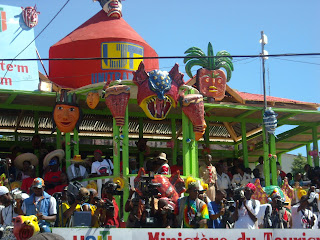 Nothing but the biggest celebration to hit the Catholic world each year, Kànaval is the last great splash before Lent begins. In
 Haiti


 Our working hypothesis is that things creative in Haiti are usually
political or religious. Yes, that is a MINUSTAH man getting mauled by a tiger.
The team's excursion
The morning after we returned from Jacmel, we loaded our team into the "bus," asSharon Haiti U.S. along the Mexico
 Our "roommate": an intrepid hermit crab.
The next day we took the boat taxi back to Cap Haitian for Kànaval. To give you a sense of what this is like inPort-au-Prince
Returning home was bittersweet: we love to travel, but living out of a bag gets old after a week or so. Hello, garden! Hello, home cooking! We missed you.
Kànaval
 Nothing but the biggest celebration to hit the Catholic world each year, Kànaval is the last great splash before Lent begins. In

 Our working hypothesis is that things creative in Haiti are usually
political or religious. Yes, that is a MINUSTAH man getting mauled by a tiger.
The morning after we returned from Jacmel, we loaded our team into the "bus," as
11 hours after leaving Desarmes we arrived in Piedra Blanca, home base of Floresta, a reforestation program actually working on both halves of the island. They have had amazing success working with the Dominican government, which has made reforestation a national priority. (Tourism is booming, and tourists would much rather see trees than bare burnt earth and some cacti.) We toured eucalyptus and cacao forests, and also checked out Floresta’s agricultural work: oregano, cilantro, and pineapple fields.

Pineapple.

Jean, looking both studious and majestic.

Chocolate in the wild.
 Learning about organic fertilizer with Rafael, a Floresta agriculturalist.
Our last day was spent taking in the sights of
Fritzner screaming to Frantzo, “Look! a road over our heads!” as we went under an overpass.
Nahomie whispering, Mezanmi! (“Oh my gosh!”) as the gate lifted after we dropped in our toll. (Tolls!)
Total silence as we drove past a big TV billboard; they sat enraptured.
It was a little sad for us that things that are so routine for us (and are actually nearly outmoded – who doesn’t have EZ-Pass?) were so remarkable to them. We so admire the bravery and persistence of Haitians in just living, but feel frustrated that it has to be that way – but we’ll leave the complexities of development for another post.
We decided to hop off the bus in Port, as we had decided to use the 5-day Kànaval weekend to take the bus south to Les Cayes to visit a friend. At the last minute, we were made an offer we couldn't refuse. Kurt (our new Country Representative – hooray!) and his girlfriend Hillary were headed north to the beach at Labadee and to check out Kànaval in Okap. The huge advantages for us: we wouldn’t have to sit on buses for hours, we could check out a place we’ve heard is unmissably great, and they could drop us off at our doorstep afterwards. We're in.
The town of

The ethereal mosquito net in our hotel room. See the greenery
outside? And the fan in the corner? That's a little slice of heaven.
outside? And the fan in the corner? That's a little slice of heaven.
 Our "roommate": an intrepid hermit crab.
The next day we took the boat taxi back to Cap Haitian for Kànaval. To give you a sense of what this is like in
Returning home was bittersweet: we love to travel, but living out of a bag gets old after a week or so. Hello, garden! Hello, home cooking! We missed you.
Tuesday, October 21, 2008
Some things to love
...about Haitian Creole.
Yes, language acquisition has been slow-going and difficult. This is despite the many times we heard that we could just "pick up Creole," which makes it sound as easy as buying a loaf of bread on the way home from work. Not so. However, I'm developing a fondness for the following:
The Bonjou Effect.
So there you are, walking along the road, and along comes a tough-looking fella on the left. He's muscular, wearing work clothes, and carrying a big machete over one shoulder. Face as impassable as the Schuylkill at rush hour. He's getting closer, still stoic, and you can almost see a fierce glint in his eyes. Just when you're about to pass each other, you say "Bonjou!" -- and he cracks the biggest smile you can image. "Bonjou, blan!" Totally transformed from Big Scary Guy to Guy Commuting to Work.
Bon.
Literally, "good." However, many Haitians use this as a transitional word, as in:
Me: Do you think we'll be back in time to go to the market?
Haitian: Bon. I think we might be able to go today.
I know it's roughly equivalent to "um," but I like to think of it as someone cheering me on. "You made sense in Creole! Good for you!"
M Renmen W.
"I love you." (Or "I like you," but let's not split hairs.) What I primarily like about this is the beautiful symmetry of the letters, and the fact that Creole lets you use single letters for all the pronouns. I suppose it's similar to writing "u" for "you" in English:
M: I
W: you
L: he, she, it
Y: they
N: we
It definitely livens up the alphabet! Speaking of which:
Alphabetization.
This is the word for literacy and literacy education. However, where this word is graffitied I like to read it as a person's fervent plea to arrange everything in alphabetical order. Forgive my inner librarian, but think of what a wonderful world that would be.
The Refrigerator is Walking.
In English, we say that things are running. The car. The fridge. The washer. (Although not the Internet, for whatever reason. That works but doesn't run.) In Creole, you can't say that machines kouri, run, but you can say that they mache, or walk. I don't know why, but walking sounds so much more physically specific to me. All these machines, getting around on their own two feet.
Ongoing Narration in Real Time.
When greeting someone, it's common to follow "hello" with a brief statement about what that person is doing.
Haitian: You're walking uphill!
Me: You're walking downhill!
And somehow it's much, much less annoying than reading billboards out loud on road trips.
Some Words That are so Useful, I Want to Bring Them Home With Me.
Degaje: Make it up as you go along.
Tet chaje: Total headache. What a hassle.
Nenpòt: It doesn't matter. Whatever's easiest. Not important.
Okay, back to degaje-ing just about everything...
Yes, language acquisition has been slow-going and difficult. This is despite the many times we heard that we could just "pick up Creole," which makes it sound as easy as buying a loaf of bread on the way home from work. Not so. However, I'm developing a fondness for the following:
The Bonjou Effect.
So there you are, walking along the road, and along comes a tough-looking fella on the left. He's muscular, wearing work clothes, and carrying a big machete over one shoulder. Face as impassable as the Schuylkill at rush hour. He's getting closer, still stoic, and you can almost see a fierce glint in his eyes. Just when you're about to pass each other, you say "Bonjou!" -- and he cracks the biggest smile you can image. "Bonjou, blan!" Totally transformed from Big Scary Guy to Guy Commuting to Work.
Bon.
Literally, "good." However, many Haitians use this as a transitional word, as in:
Me: Do you think we'll be back in time to go to the market?
Haitian: Bon. I think we might be able to go today.
I know it's roughly equivalent to "um," but I like to think of it as someone cheering me on. "You made sense in Creole! Good for you!"
M Renmen W.
"I love you." (Or "I like you," but let's not split hairs.) What I primarily like about this is the beautiful symmetry of the letters, and the fact that Creole lets you use single letters for all the pronouns. I suppose it's similar to writing "u" for "you" in English:
M: I
W: you
L: he, she, it
Y: they
N: we
It definitely livens up the alphabet! Speaking of which:
Alphabetization.
This is the word for literacy and literacy education. However, where this word is graffitied I like to read it as a person's fervent plea to arrange everything in alphabetical order. Forgive my inner librarian, but think of what a wonderful world that would be.
The Refrigerator is Walking.
In English, we say that things are running. The car. The fridge. The washer. (Although not the Internet, for whatever reason. That works but doesn't run.) In Creole, you can't say that machines kouri, run, but you can say that they mache, or walk. I don't know why, but walking sounds so much more physically specific to me. All these machines, getting around on their own two feet.
Ongoing Narration in Real Time.
When greeting someone, it's common to follow "hello" with a brief statement about what that person is doing.
Haitian: You're walking uphill!
Me: You're walking downhill!
And somehow it's much, much less annoying than reading billboards out loud on road trips.
Some Words That are so Useful, I Want to Bring Them Home With Me.
Degaje: Make it up as you go along.
Tet chaje: Total headache. What a hassle.
Nenpòt: It doesn't matter. Whatever's easiest. Not important.
Okay, back to degaje-ing just about everything...
Sunday, September 28, 2008
The Vote is In
Yesterday we attended the annual meeting for ODD (Organization for the Development of Desarmes). They're one of MCC's partners here; they also plant trees, work with irrigation, and are trying to get a trade school off the ground.
At this meeting, they needed to vote in some new board members and new members for the oversight committee. After a long period of people nominating others (or themselves), we eventually had 7 candidates, 5 men and 2 women, for 3 open positions. Each candidate had three minutes to promote themselves before the election. Following the speeches, there is a brief silence and all heads look to us. I must have missed the announcement that they needed voting monitors. They thought we would do just fine.
A stack of notecards was produced, and I thought, "oh, those are the ballots and you write in the name of the person you like and that's that" -- nope, not quite that simple. The notecards were indeed for the candidates, but there was no writing in. Four candidates were represented by colored cards, one by bottlecaps, one by pebbles, and one by cardboard.
So into a dark hallway we went, with a basket at our feet. Each person came in to cast up to three votes, once for each open position. Theoretically, a person could toss in 1 pink notecard, 1 bottlecap, and 1 piece of cardboard. We were there to make sure they put in no more than three votes. We asked if someone could use all three of their votes for the same person, and one of the ODD officials said, surprisingly, "yes, that's not a problem." Well, it turns out that someone did cast three votes for one candidate -- it actually was Mr. Bottlecap, the candidate himself!
We emerged from the dark hallway with the basket of votes and hoped no rocks fell through the cracks as we carried it over. After we sat down, we asked Jean-Remy if it really was OK for one person to vote for the same candidate three times. His eyes widened, he clarified our butchered Kreyol and said "no, that is not allowed" -- paused and said, "We'll wait and see how the vote turns out. If there's a problem will address it later."
So the votes come in: 49 votes for Pink Notecard, 47 votes for Blue Notecard, and 29 votes for Bottlecap (ah! He's in 3rd place!), 4 votes for Cardboard, 17 for Pebble, 19 for White Notecard and...22, 23, 24, 25....votes for Green Notecard. So close! Mr. Bottlecap only wins by a hair if you take away his two illegal votes. Thrilling.
We thought it was a pretty ingenious way to allow people who may be illiterate to participate local politics, and we were impressed that they took it so seriously.
At this meeting, they needed to vote in some new board members and new members for the oversight committee. After a long period of people nominating others (or themselves), we eventually had 7 candidates, 5 men and 2 women, for 3 open positions. Each candidate had three minutes to promote themselves before the election. Following the speeches, there is a brief silence and all heads look to us. I must have missed the announcement that they needed voting monitors. They thought we would do just fine.
A stack of notecards was produced, and I thought, "oh, those are the ballots and you write in the name of the person you like and that's that" -- nope, not quite that simple. The notecards were indeed for the candidates, but there was no writing in. Four candidates were represented by colored cards, one by bottlecaps, one by pebbles, and one by cardboard.
So into a dark hallway we went, with a basket at our feet. Each person came in to cast up to three votes, once for each open position. Theoretically, a person could toss in 1 pink notecard, 1 bottlecap, and 1 piece of cardboard. We were there to make sure they put in no more than three votes. We asked if someone could use all three of their votes for the same person, and one of the ODD officials said, surprisingly, "yes, that's not a problem." Well, it turns out that someone did cast three votes for one candidate -- it actually was Mr. Bottlecap, the candidate himself!
We emerged from the dark hallway with the basket of votes and hoped no rocks fell through the cracks as we carried it over. After we sat down, we asked Jean-Remy if it really was OK for one person to vote for the same candidate three times. His eyes widened, he clarified our butchered Kreyol and said "no, that is not allowed" -- paused and said, "We'll wait and see how the vote turns out. If there's a problem will address it later."
So the votes come in: 49 votes for Pink Notecard, 47 votes for Blue Notecard, and 29 votes for Bottlecap (ah! He's in 3rd place!), 4 votes for Cardboard, 17 for Pebble, 19 for White Notecard and...22, 23, 24, 25....votes for Green Notecard. So close! Mr. Bottlecap only wins by a hair if you take away his two illegal votes. Thrilling.
We thought it was a pretty ingenious way to allow people who may be illiterate to participate local politics, and we were impressed that they took it so seriously.
Sunday, September 14, 2008
Any Port-au-Prince in a storm
We've been trying to head out to Desarmes for the last week or so, but the recent hurricanes damaged roads and delayed our move until this coming Tuesday (si dye vle, if God wants). It's been nice to have a little more time to explore this complex city.
Some highlights:
-Wall murals of uplifting sayings by a somewhat mysterious organization.
-Paintings, and copies of paintings, for sale everywhere.
-Goats grazing on a little strip of grass at the gas station.
-Two amazing things that I haven't yet photographed: the ultracolorful tap-taps, the truck-taxis that are public transportation, and the painted portraits advertising hair salons throughout the city. Stay tuned.
-Frequent electricity. Frequent internet access.
-The fact that I think about Celine Dion every day, because the water trucks (think ice cream trucks) play the theme from Titanic loudly and often, on ice-cream-truck-quality speakers.
-Creole lessons with a professional tutor. Seriously. He wrote our textbook.
-Swimming pools at fancy hotels.
The following:
So, moving to Desarmes. The current plan is for us to drive to the river on Tuesday, cross a bridge on foot with all our stuff, and meet the reforestation team and their truck on the other side. Because we've heard that the market in Desarmes is still closed because of flooding, we're planning to take food for several weeks with us. It's unclear whether Ben and Alexis will come with us for a week or whether they'll postpone their visit even further.
The Artibonite Valley was definitely affected by the hurricanes, but definitely not as severely as Gonaives and other cities in Haiti. MCC is currently raising support for material aid: you can read their official press release here.
Some highlights:
-Wall murals of uplifting sayings by a somewhat mysterious organization.
-Paintings, and copies of paintings, for sale everywhere.
-Goats grazing on a little strip of grass at the gas station.
-Two amazing things that I haven't yet photographed: the ultracolorful tap-taps, the truck-taxis that are public transportation, and the painted portraits advertising hair salons throughout the city. Stay tuned.
-Frequent electricity. Frequent internet access.
-The fact that I think about Celine Dion every day, because the water trucks (think ice cream trucks) play the theme from Titanic loudly and often, on ice-cream-truck-quality speakers.
-Creole lessons with a professional tutor. Seriously. He wrote our textbook.
-Swimming pools at fancy hotels.
The following:
So, moving to Desarmes. The current plan is for us to drive to the river on Tuesday, cross a bridge on foot with all our stuff, and meet the reforestation team and their truck on the other side. Because we've heard that the market in Desarmes is still closed because of flooding, we're planning to take food for several weeks with us. It's unclear whether Ben and Alexis will come with us for a week or whether they'll postpone their visit even further.
The Artibonite Valley was definitely affected by the hurricanes, but definitely not as severely as Gonaives and other cities in Haiti. MCC is currently raising support for material aid: you can read their official press release here.
Thursday, August 28, 2008
Gustav
Hurricane #2, and we are okay.
Imagine a snow--when it starts to snow and everyone calls out of work and school gets cancelled and everyone watches the weather all day to find out that...yes indeed, it is snowing. Well, here in Haiti there is no snow. When it rains everyone stays home, calls out of work, the stores don't open and everyone listens to the radio to find out that...yes indeed, it is raining. To call it a "hurricane" is probably correct, but we experienced only rain--three days of steady rain. Not heavy hurricane rain, just steady rain for about 3 days. When the rain finally stopped and people emerged again, we asked what they had done for the past three days, and the common response was "We stayed in bed all day." We learned from our Haitian friends to take it easy, so we got out of bed late and busied ourselves with Scrabble (in English and Creole), a movie, and some reading.
In other news, this morning we arrived in Port-au-Prince for the last leg of our orientation. We'll be here for a little more than a week, taking Creole lessons, setting up a bank account, and learning things like How to Drive a Motorcycle in Swiftly Moving Traffic. Then we're on to Desarmes on September 6!
Until the next hurricane.....
Imagine a snow--when it starts to snow and everyone calls out of work and school gets cancelled and everyone watches the weather all day to find out that...yes indeed, it is snowing. Well, here in Haiti there is no snow. When it rains everyone stays home, calls out of work, the stores don't open and everyone listens to the radio to find out that...yes indeed, it is raining. To call it a "hurricane" is probably correct, but we experienced only rain--three days of steady rain. Not heavy hurricane rain, just steady rain for about 3 days. When the rain finally stopped and people emerged again, we asked what they had done for the past three days, and the common response was "We stayed in bed all day." We learned from our Haitian friends to take it easy, so we got out of bed late and busied ourselves with Scrabble (in English and Creole), a movie, and some reading.
In other news, this morning we arrived in Port-au-Prince for the last leg of our orientation. We'll be here for a little more than a week, taking Creole lessons, setting up a bank account, and learning things like How to Drive a Motorcycle in Swiftly Moving Traffic. Then we're on to Desarmes on September 6!
Until the next hurricane.....
Sunday, August 10, 2008
The art of the question
When I was preparing to come to Haiti, I had a lot of questions about Haiti's art scene. Given that the arts are often the first to lose funding in the U.S., I wondered what keeps the creative drive alive in a culture that faces so many material challenges. Over the last few days, we've had the opportunity to explore several different genres: metalworking, music, painting, beadworking, sculpture, dance, and woodworking.
The first artisans we visited were primarily commercial, and I wondered if the answer to my question of what vitalizes the arts here is simply the fact that it can be lucrative. (I'm not sure if it's still true, but at one point Haitians were producing handcrafts that were sold throughout the Caribbean.) Is money truly what keeps creativity alive, when it comes down to the essence of survival?
However--and quite fortunately--it turns out that Haiti is not a land of easy answers. The joy of creation has been more than evident in the work of several of the artists we've met here, and it seems that art is alive and well beyond the marketplace.
This is a rather simplistic outline of the question, but I've again run out of computer time...and I again welcome your thoughts on the matter.
The first artisans we visited were primarily commercial, and I wondered if the answer to my question of what vitalizes the arts here is simply the fact that it can be lucrative. (I'm not sure if it's still true, but at one point Haitians were producing handcrafts that were sold throughout the Caribbean.) Is money truly what keeps creativity alive, when it comes down to the essence of survival?
However--and quite fortunately--it turns out that Haiti is not a land of easy answers. The joy of creation has been more than evident in the work of several of the artists we've met here, and it seems that art is alive and well beyond the marketplace.
This is a rather simplistic outline of the question, but I've again run out of computer time...and I again welcome your thoughts on the matter.
Tuesday, August 5, 2008
Gwo Jean
So, we are still here in Gwo Jan. We are near Port au Prince but it feels very rural, with pigs, chickens, goats, etc. all roaming about. This past weekend we hiked to the top of a mountain--and we now know Haiti is all mountains. So going "up" the mountain mean going up and down almost equally to finally go....up. We relaxed at a guest house at the top and hung out with our new MCC co-workers playing a made-up version of Apples to Apples with our own words. The hike itself took about 4 hours each way and we were chased by storm clouds both up and down, and were finally caught in a downpour on our way "down" (read: going up mostly). We saw a nice forested area at the top with streams and waterfalls; overall, it was a really pretty place. (And we had a great time in all, despite the fact that Sharon was sick all night long on Saturday...there's nothing like trying to sleep in a tent with a dozen people around and having to get up every hour to vomit. Fun. She's better now, though.)
Since Monday we've been back at Gwo Jan with daily trips to Port au Prince. Today we wandered around a bit to see fair trade woodworkers and a supplier for 10,000 Villages. The day was exhausting even though we did nothing but sit and listen mostly, but I guess it is "trying" to listen and understand that is exhausting. For me personally (Bryan) the language training is difficult. I feel like I've been given the keys to drive after never seeing a car before and getting only a Cliff Notes version of drivers ed. I get really frustrated and just need to calm down and not be so hard on myself, but I feel like I should be learning faster, which makes it hard to calm down.
We are also having a "homestay" which means sleeping and eating with a family in the village. We've only been there for one night so far, so I can't give an average day's account as of yet, but maybe in the next post I will. Our schedule is mostly unknown to us, but I do know we are going to Cap Haitian on the 14th--so pull out your maps and check it out.
Since Monday we've been back at Gwo Jan with daily trips to Port au Prince. Today we wandered around a bit to see fair trade woodworkers and a supplier for 10,000 Villages. The day was exhausting even though we did nothing but sit and listen mostly, but I guess it is "trying" to listen and understand that is exhausting. For me personally (Bryan) the language training is difficult. I feel like I've been given the keys to drive after never seeing a car before and getting only a Cliff Notes version of drivers ed. I get really frustrated and just need to calm down and not be so hard on myself, but I feel like I should be learning faster, which makes it hard to calm down.
We are also having a "homestay" which means sleeping and eating with a family in the village. We've only been there for one night so far, so I can't give an average day's account as of yet, but maybe in the next post I will. Our schedule is mostly unknown to us, but I do know we are going to Cap Haitian on the 14th--so pull out your maps and check it out.
Subscribe to:
Posts (Atom)